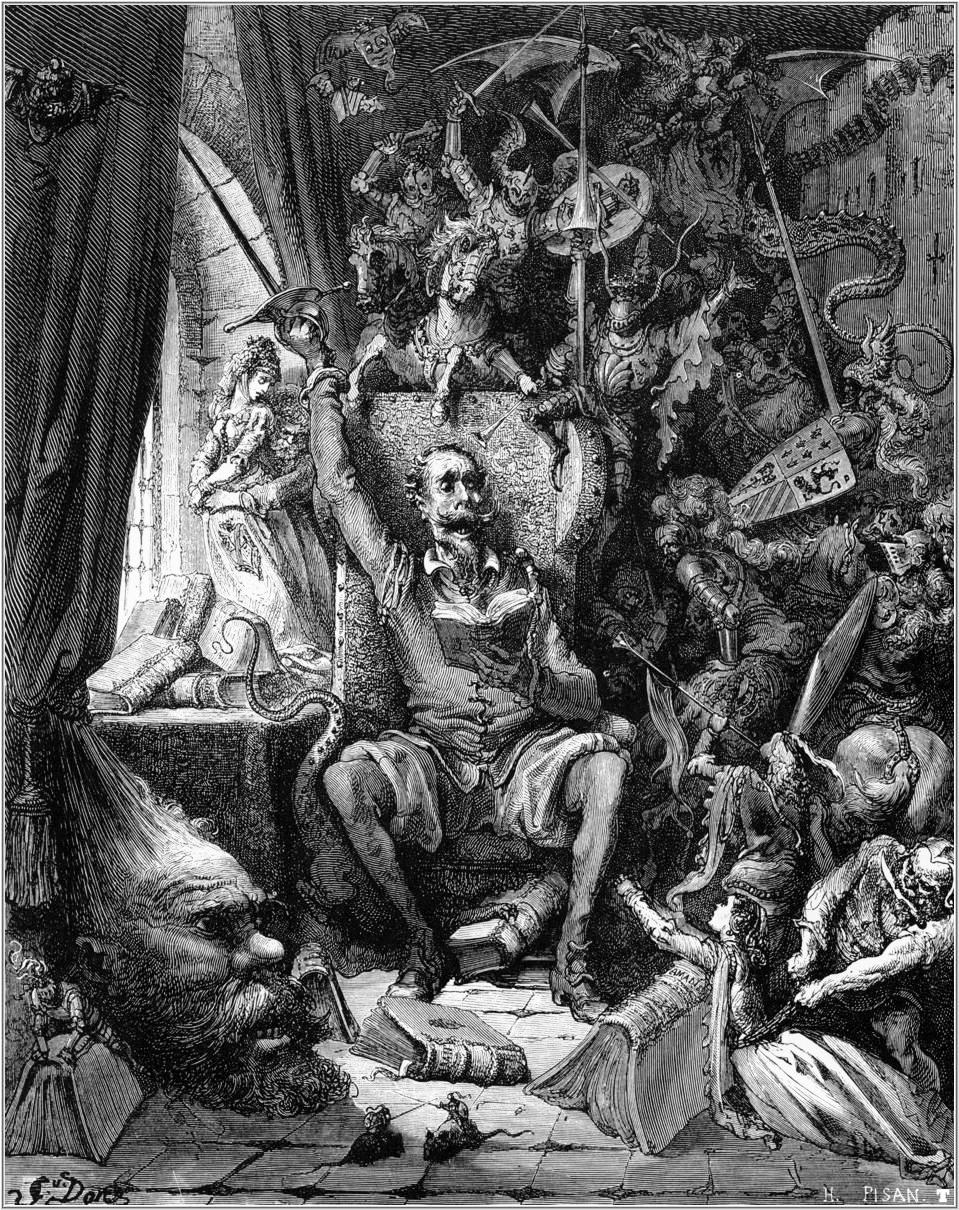


From the 1863 illustrated edition of Cervantes's Don Quixote, this Doré engraving shows Don Quixote in his library surrounded by chivalric romances, the books that have driven his imagination into the conviction that he is a knight-errant. Doré captures the moment Cervantes pinpoints at the opening of Part I, Chapter 1: 'a world of disorderly notions, picked out of his books, crowded into his imagination.' Volumes spill from shelves; the Don gestures upward; a candle burns through the night.
Doré illustrated Don Quixote between 1862 and 1863 as part of the great series of literary commissions that included Dante's Inferno, Milton's Paradise Lost, La Fontaine's Fables, Coleridge's Rime of the Ancient Mariner, and the Bible. The Don Quixote series was the single project for which Doré is most often remembered; the Doré-Cervantes pairing has remained the canonical visual interpretation of the novel for over 160 years.
The engraving is in the public domain. Cervantes's Don Quixote, published in two volumes in 1605 and 1615, is the foundation novel of European literary fiction. Modern surveys of the novel as a form routinely place Don Quixote first in the historical sequence; the Doré illustrations are the visual layer most readers now meet the book through.