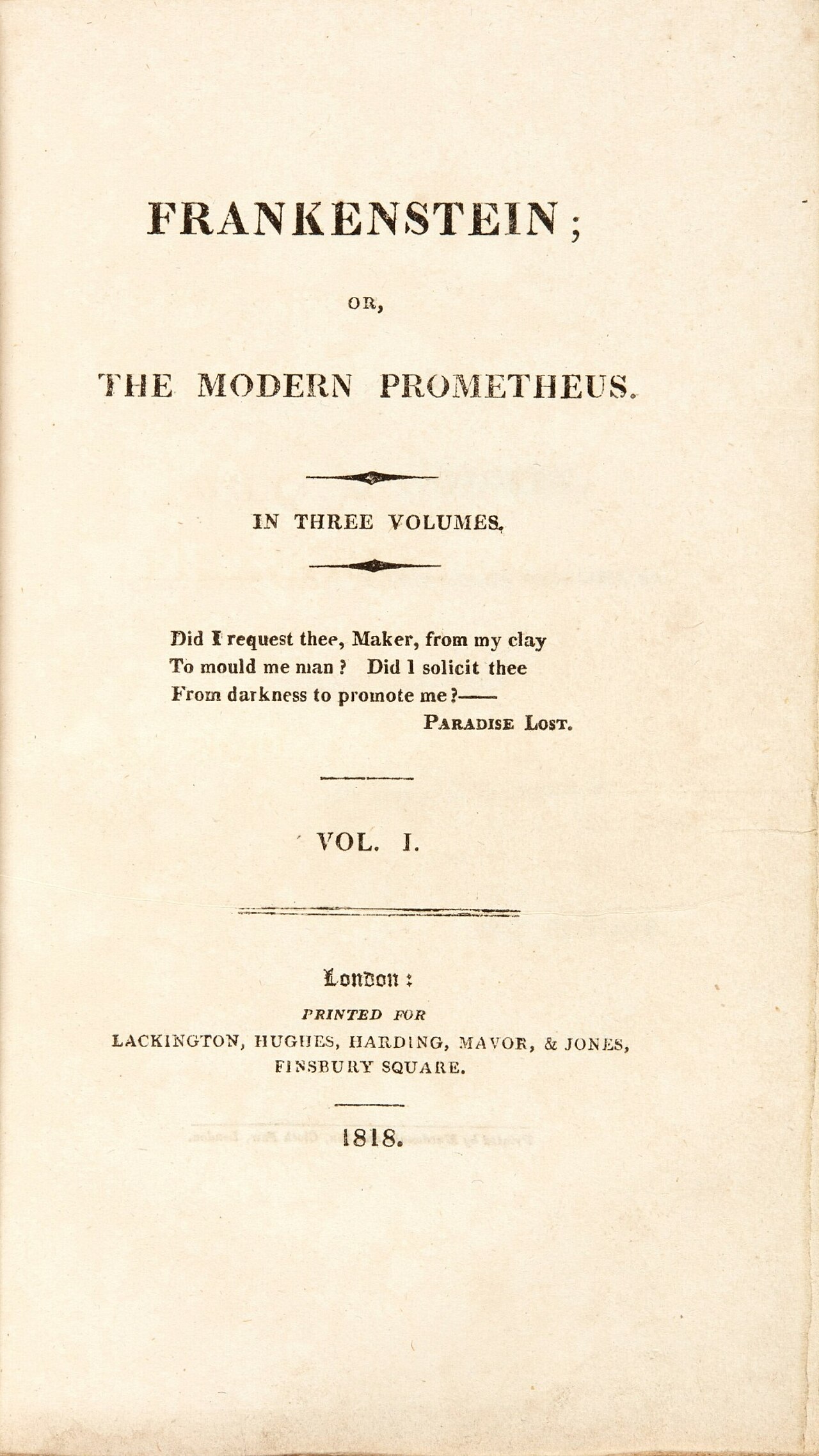


The title page of the 1818 first edition of Frankenstein; or, The Modern Prometheus, published anonymously in three volumes by Lackington, Hughes, Harding, Mavor, and Jones. The novel was Mary Shelley's first; she was nineteen when she began writing it, twenty-one when it was published. Her authorship was not publicly confirmed until the 1823 second edition.
The book emerged from the famous summer of 1816 at the Villa Diodati on Lake Geneva, where Mary and Percy Shelley were the guests of Lord Byron during the 'year without a summer' caused by the eruption of Mount Tambora. Byron proposed the ghost-story competition that produced both Frankenstein and Polidori's The Vampyre. Mary Shelley wrote the first draft of Frankenstein between September 1816 and April 1817; revisions continued through summer 1817 before publication on 1 January 1818.
Frankenstein is the founding novel of science fiction, of the Gothic-meets-Romantic mode, and of every subsequent literary or filmic reflection on technological hubris. The 1818 first edition is the textual form preserved most carefully, the 1831 revised edition is more widely reprinted but takes the original in significant directions Mary Shelley herself preferred at the time. The first-edition title page is the most direct physical evidence of the book's literary moment of origin.