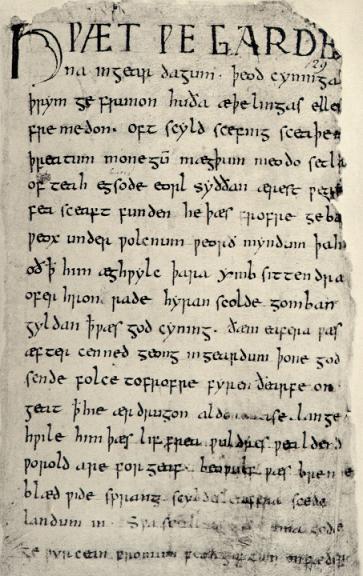


The opening folio of the only surviving manuscript of Beowulf, Cotton Vitellius A.xv at the British Library. The poem was composed at some point between the 8th and 11th centuries; the manuscript copy that survives is dated to around 1000 CE. The first folio opens with the famous 'Hwæt!', translated by Seamus Heaney as 'So.', the formal opening exclamation that gathers the listener's attention before the genealogy of the Danes begins.
The manuscript narrowly survived the 1731 Ashburnham House fire that destroyed much of the Cotton Library; the surviving folios show scorching and edge damage. The poem itself is the longest single piece of Old English literature: 3,182 alliterative lines describing the hero Beowulf's three great battles, Grendel, Grendel's Mother, and the Dragon, and the cultural and political world that contains them.
Beowulf is the foundation document of English-language literary tradition. Its iconography (mead-hall, monster-as-outsider, gold-as-doom, warrior-king, the boast as oath) shaped J.R.R. Tolkien's scholarly career and through him much of twentieth-century mythopoeic fiction. The manuscript itself is the British Library's most consulted Anglo-Saxon artifact.