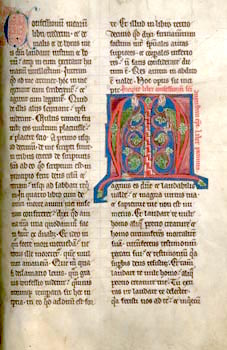


Augustine wrote the Confessions in Latin between 397 and 400 CE, in his early forties, while he was Bishop of Hippo Regius in Roman North Africa. The work is thirteen books long, structured as a sustained address to God in the second person singular. "Tu autem, Domine, scis omnia," you, Lord, know everything: the address is to a reader who does not need to be informed but who is summoned anyway, as witness. The book invents the form of autobiography that Western literature has used ever since. Before Augustine, classical writing about the self was either philosophical (Plato's letters, Marcus Aurelius's meditations) or rhetorical (Cicero's speeches, Caesar's commentaries). None of it had the structure Augustine produced: a continuous narrative of a single life, written from a converted standpoint, with the unconverted earlier self treated as both estranged and continuous.
The first nine books are autobiography in the strict sense. Augustine narrates his life from infancy through his Manichean phase, his rhetorical career in Carthage and Milan, his concubine and son, his hearing of Ambrose's sermons, the famous garden scene in which a child's voice singing "tolle lege" (take and read) sends him to open Paul's letters and convert. Book Ten turns inward and produces what is probably the founding philosophical text on memory, treating the mind as "a vast cavern, a measureless palace." Books Eleven through Thirteen turn to creation, with a meditation on time ("What then is time? If no one asks me, I know; if I wish to explain it to one who asketh, I know not") and a verse-by-verse reading of Genesis.
The achievement is the structural decision. Augustine narrates his pre-conversion life as a Christian narrator would narrate it: with judgement, with the foreknowledge of the conversion, with the framing of every sin as something the conversion will eventually redeem. But he also reproduces the pre-conversion self's logic, faithfully enough that the narrative makes sense from inside. The reader is asked to hold both perspectives at once, the lost self and the saved self, without flattening either. This double standpoint is the engine of every subsequent autobiography in the Augustinian tradition: Petrarch's letter to posterity, Rousseau's Confessions, De Quincey's Confessions of an English Opium-Eater, the modern memoir of recovery. Augustine invented the structure they all use.
The Confessions has been continuously in print, in some Latin manuscript or translation, for over sixteen hundred years. It is among the small set of texts (perhaps a dozen across the entire history of Western literature) whose readership has not lapsed since the work's composition. Augustine wrote it in his forties, with the assumption that a written confession to God could double as a public document instructing other readers. The assumption has held.