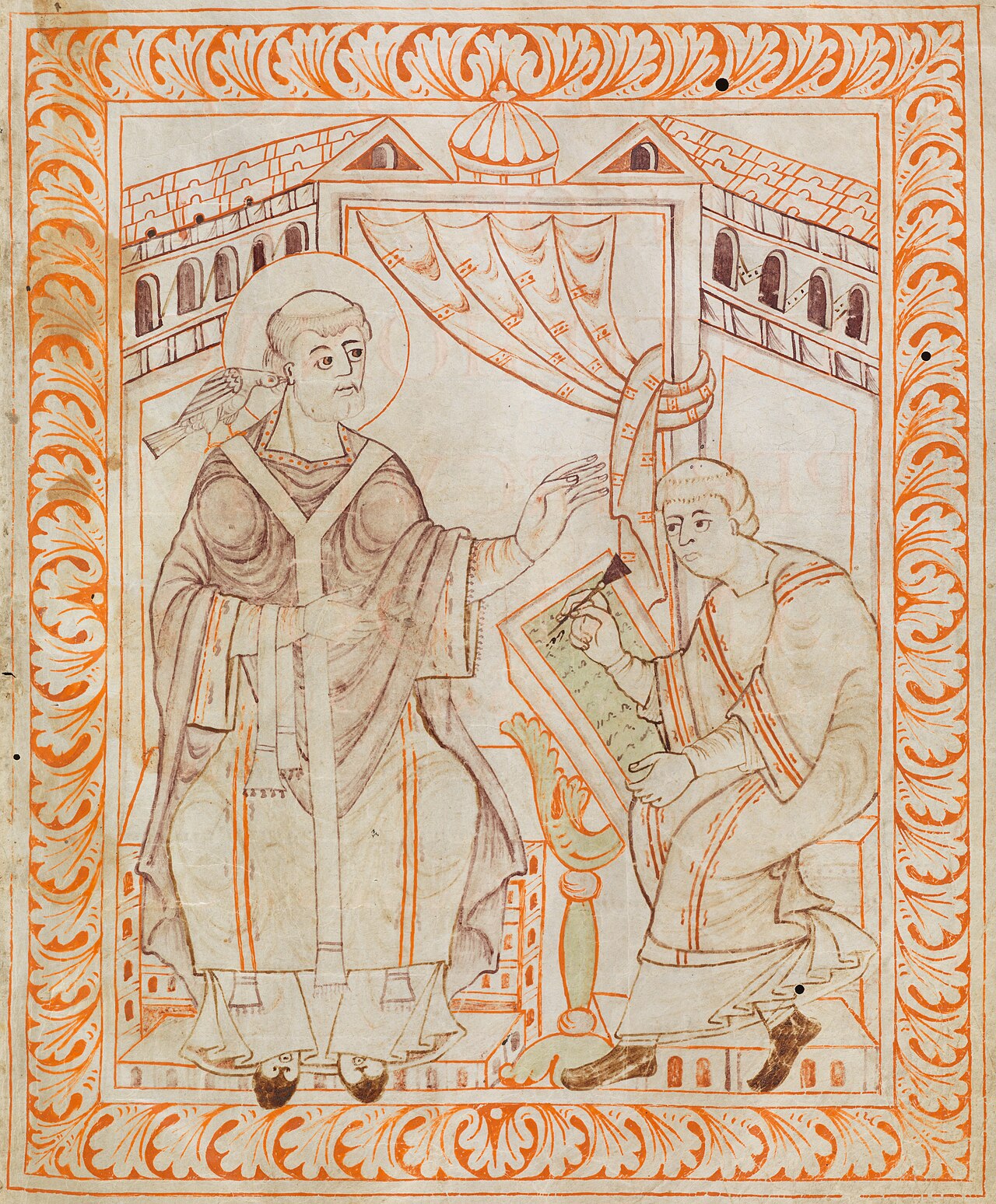



This opening folio of the Antiphonary of Hartker depicts Pope Gregory I (the Great) seated at his writing desk with the dove of the Holy Spirit at his ear dictating the chants that, according to Carolingian tradition, the pope had compiled and arranged into the standard liturgical repertory of the Western church. The manuscript is one of the oldest substantially complete antiphonaries with neume notation, produced at the monastery of Sankt Gallen in the abbey scriptorium around the year 1000 by the recluse Hartker.
The Antiphonary of Hartker (St. Gallen, Stiftsbibliothek, Cod. Sang. 390 and 391) preserves the chants for the Divine Office (matins, lauds, vespers, and the lesser canonical hours) of the entire liturgical year. The notation is in St. Gallen neumes, the most sophisticated of the early adiastematic (non-staff) notation systems, capable of preserving extremely fine performance details: ornaments, articulations, microtonal inflections, and vocal effects that staff notation would later flatten out. The Hartker manuscript is one of the principal sources for the modern reconstruction of medieval Gregorian chant performance practice undertaken by the monks of Solesmes in the nineteenth and twentieth centuries.
The two volumes are held at the Stiftsbibliothek Sankt Gallen, the medieval monastic library of one of the great Carolingian and Ottonian centers of learning. The library was founded in the 8th century, holds approximately 170,000 books, and is a UNESCO World Heritage Site. The Hartker Antiphonary is one of the founding monuments of European music notation history: between this manuscript and the introduction of the four-line staff by Guido of Arezzo around 1025, the entire technology of Western musical literacy was invented and refined within the Benedictine monastic system.