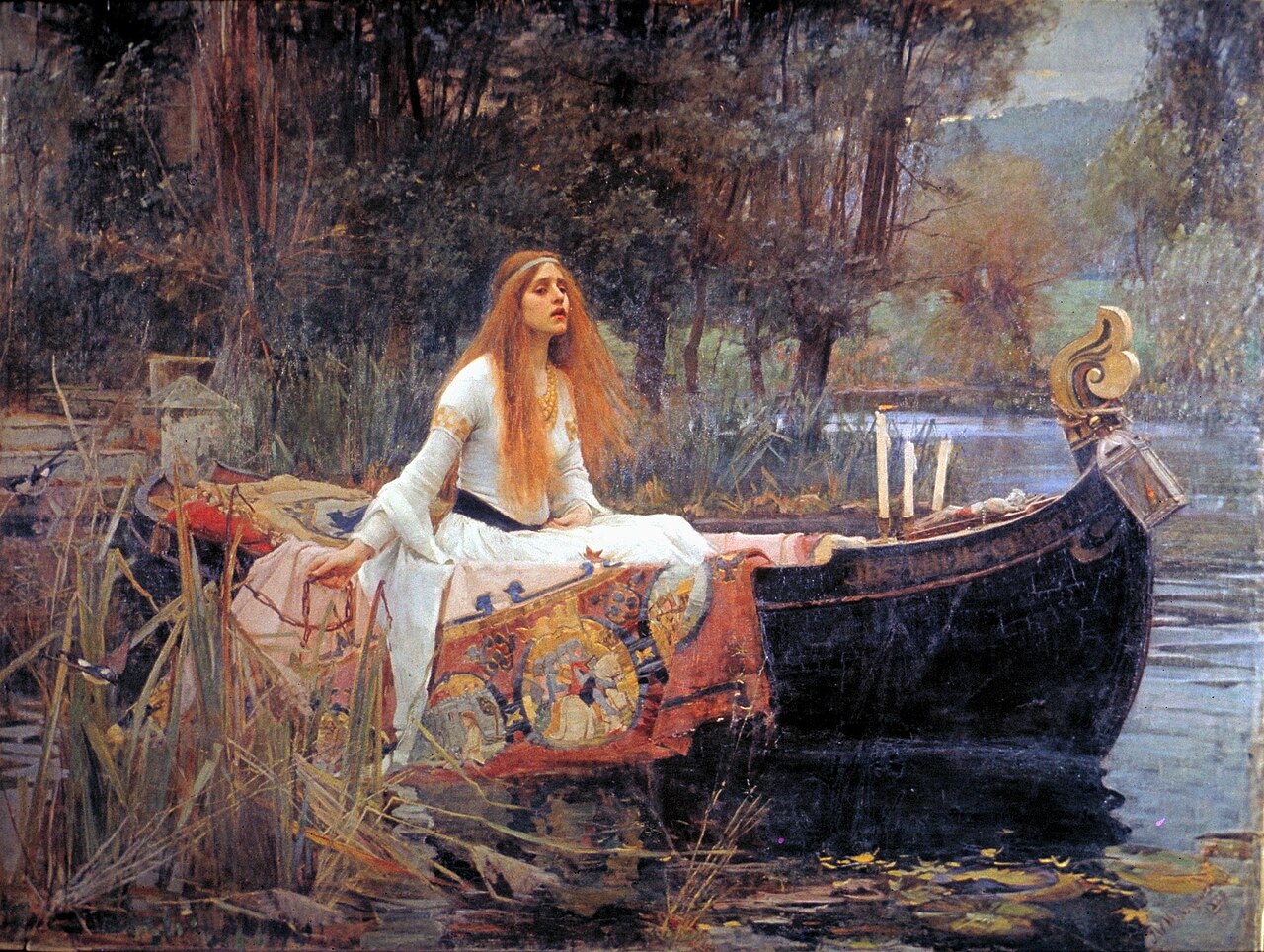


Painted in 1888, Waterhouse's The Lady of Shalott illustrates the climactic stanza of Tennyson's 1832 poem: the Lady, having looked directly at Lancelot in the mirror and broken the curse, leaves her tower, lies down in a boat, and floats down the river toward Camelot, singing as she dies. She holds a chain in one hand, releasing the boat from its mooring; a candle, almost out, sits at the prow. The tapestry she had been weaving lies draped over the side of the boat.
Waterhouse worked the picture in a deeply Pre-Raphaelite register inherited from Hunt, Millais, and Burne-Jones but pushed into a more cinematic and atmospheric mode. The trees overhead are painted with documentary realism; the boat with iconographic precision. The Lady herself is at the threshold between Pre-Raphaelite figuration and Symbolist allegory, she is both a specific Arthurian character and a personification of the artist-as-witness who cannot look directly at the world.
The painting is in Tate Britain, where it remains one of the most photographed canvases. Waterhouse painted the subject twice more (1894 and 1916); the 1888 version is the one most commonly referred to as 'The Lady of Shalott' without qualification.