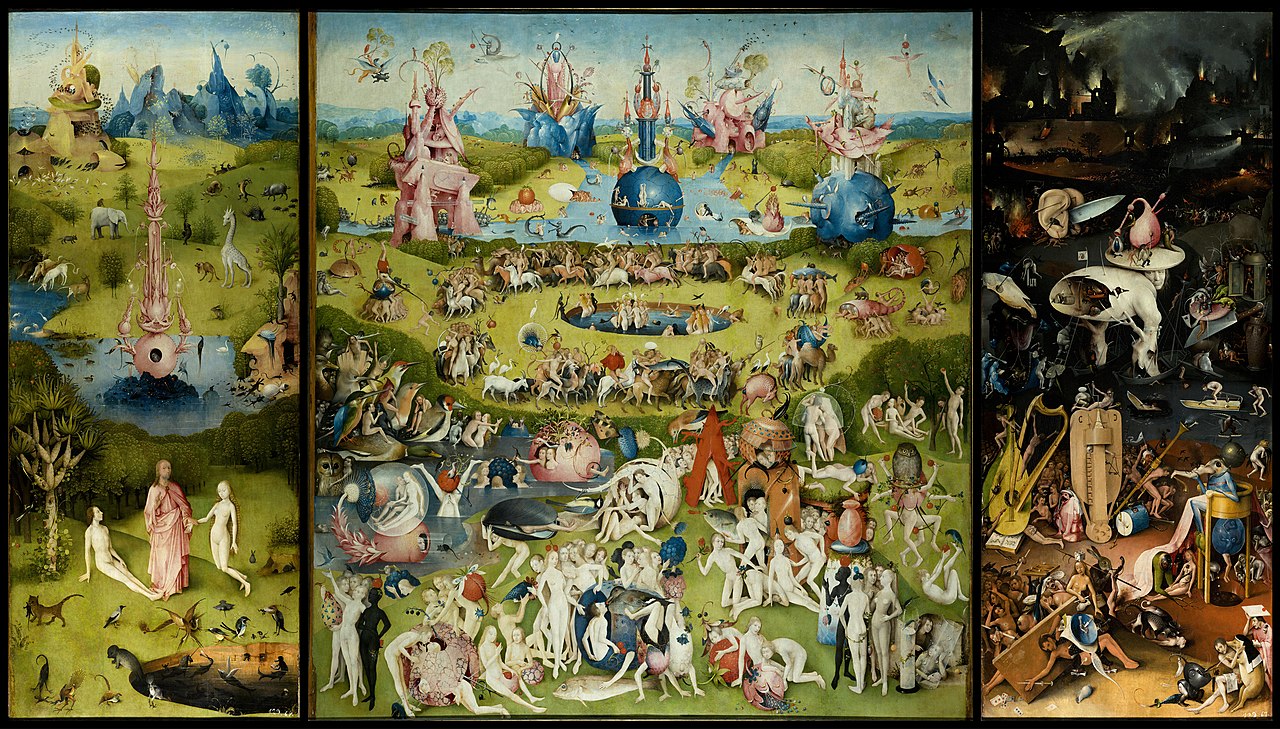


Five centuries of writing have not produced a stable reading of this triptych, and the failure is significant. Most paintings yield to interpretation by the second generation of critics. Bosch's central panel does not. The figures eat strawberries, ride composite beasts, inhabit transparent capsules, and embrace in inexplicable configurations, all moving without urgency. They are not labelled. They are not assembled into the visual sentences medieval moralising painting depends on. There is no obvious sermon and no obvious sin. The central panel is the largest section of the triptych and the section commentators most reliably fail to settle.
The instinct, faced with this, has been to read backwards from the third panel. The right wing is a black-skyed Hell of musical instruments turned to instruments of torment, fish-headed devils, recognisable damnations. If the right panel is Hell, the reasoning goes, the central panel must be the world of human pleasure that earns Hell, and therefore must itself be sinful, however serenely it is painted. This makes the painting orthodox. It also makes the central panel narratively redundant: a long elaboration of sin that adds nothing the right panel does not already deliver.
A harder reading: the centre is not a moral diagnosis. It is a refusal to deliver one. Bosch has built a world of strangeness on its own terms, without judgement, and has placed Hell beside it not as consequence but as adjacency. The viewer who needs the central panel to be a sermon supplies the sermon themselves. The painting does not. The Prado keeps it in a dedicated room because no other context will hold it; the triptych argues with whatever painting it is placed next to. Five centuries of interpretive failure is the painting's most consistent feature, and probably its actual subject.