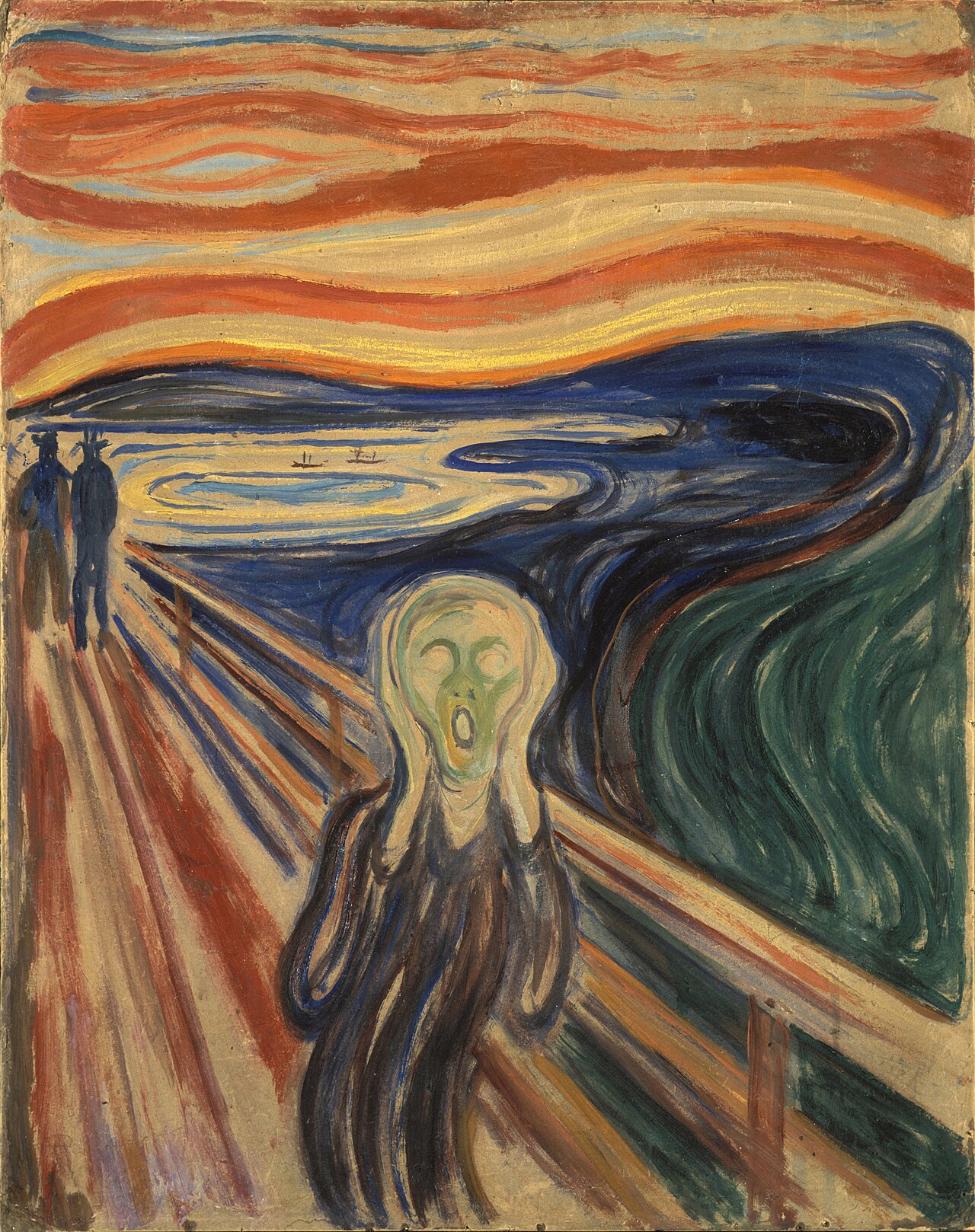


Painted in 1893, The Scream is the defining image of European proto-expressionism and one of the most reproduced artifacts in cultural history. A figure on a bridge holds its head and emits a wordless cry; a blood-orange sky burns over a fjord. Munch made multiple versions across his career, two paintings, two pastels, and a lithograph, but the 1893 painting in the National Museum of Norway is the canonical form.
Munch's diary entry records the origin: he was walking on a path above Oslofjord with two friends when, in his own words, he felt 'a great unending scream piercing through nature.' The picture was composed around that single phrase. Its formal innovations, the swirl that absorbs sky, landscape, and figure into a single continuous distortion, collapse Symbolist iconography and Expressionist gesture twenty years before the latter movement formally existed.
The painting is held in the National Museum of Norway. Two versions of The Scream have been stolen and recovered in the modern era; the cultural-historical fact that this is the only image considered worth stealing more than once is itself evidence of its standing as the most weight-bearing single artifact in late nineteenth-century European visual culture.