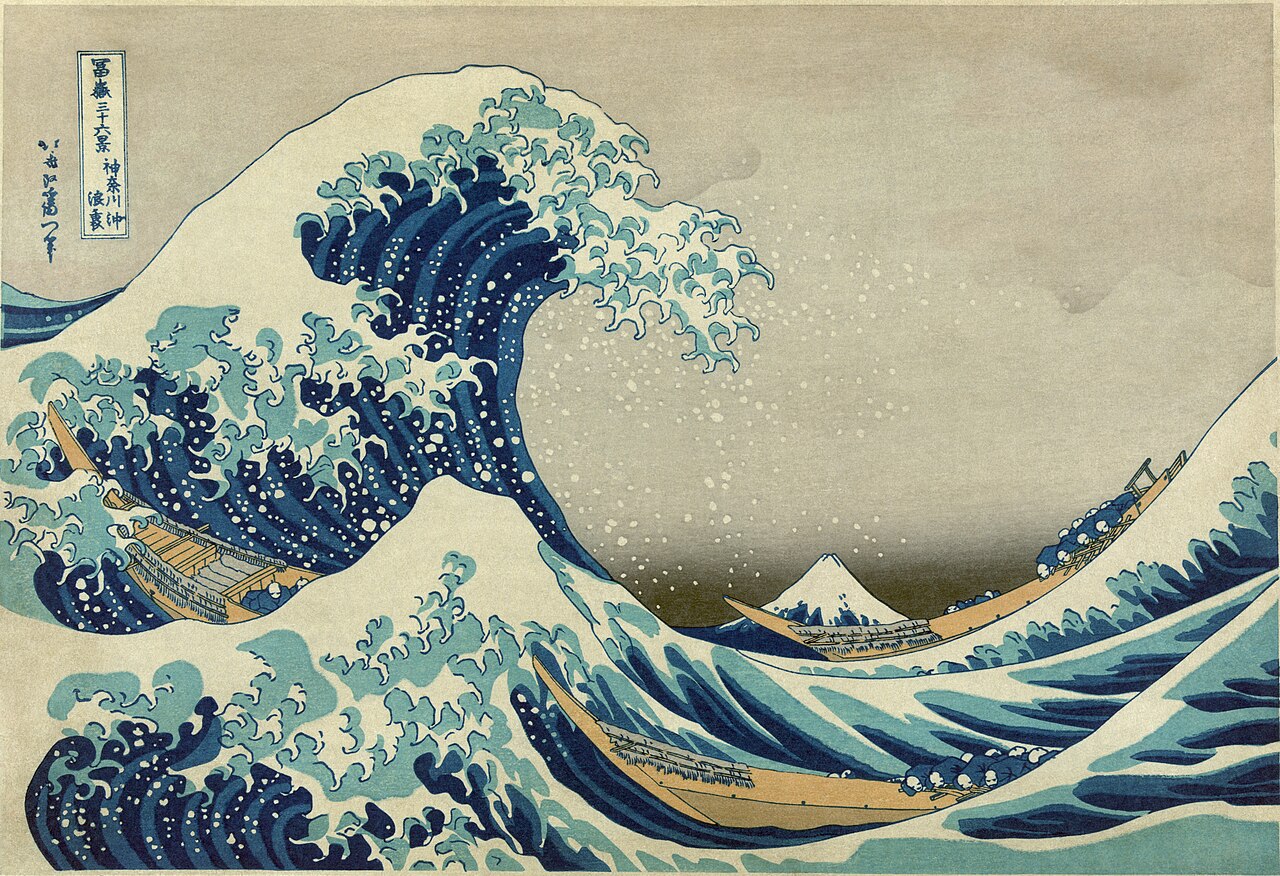



Created around 1831 as part of Hokusai's series Thirty-six Views of Mount Fuji (Fugaku Sanjūrokkei), The Great Wave off Kanagawa (Kanagawa-oki Nami-ura) is the single most-recognized image of Japanese art across world visual culture. A monumental wave breaks over three fishing boats while Mount Fuji appears small and stable on the horizon between the wave's claw-fingered foam and the boats below. The composition foregrounds the wave; Fuji is a tiny but anchoring counterweight.
Hokusai (1760-1849) was working at age 70 when he produced the Thirty-six Views series; he continued working until his death at age 89 ('From the age of six I have had a passion for copying the form of things... If only Heaven will give me just another ten years... Just another five more years, then I could become a real painter.'). The Great Wave is print no. 1 in the series and was reprinted in vast numbers, original 19th-century impressions number perhaps in the thousands, with hundreds of complete sets of the Thirty-six Views surviving in museum collections worldwide.
The print's composition shaped European modernist visual culture from the 1860s through the 1920s, Whistler, Degas, Cassatt, Monet, Van Gogh, Klimt, Toulouse-Lautrec all collected and copied Hokusai. The Great Wave is the canonical artifact of the Japonisme cultural moment that transformed European decorative arts at the threshold of modernism. It is held in major impressions at the Metropolitan Museum of Art, the British Museum, the Bibliothèque nationale de France, and dozens of other collections.