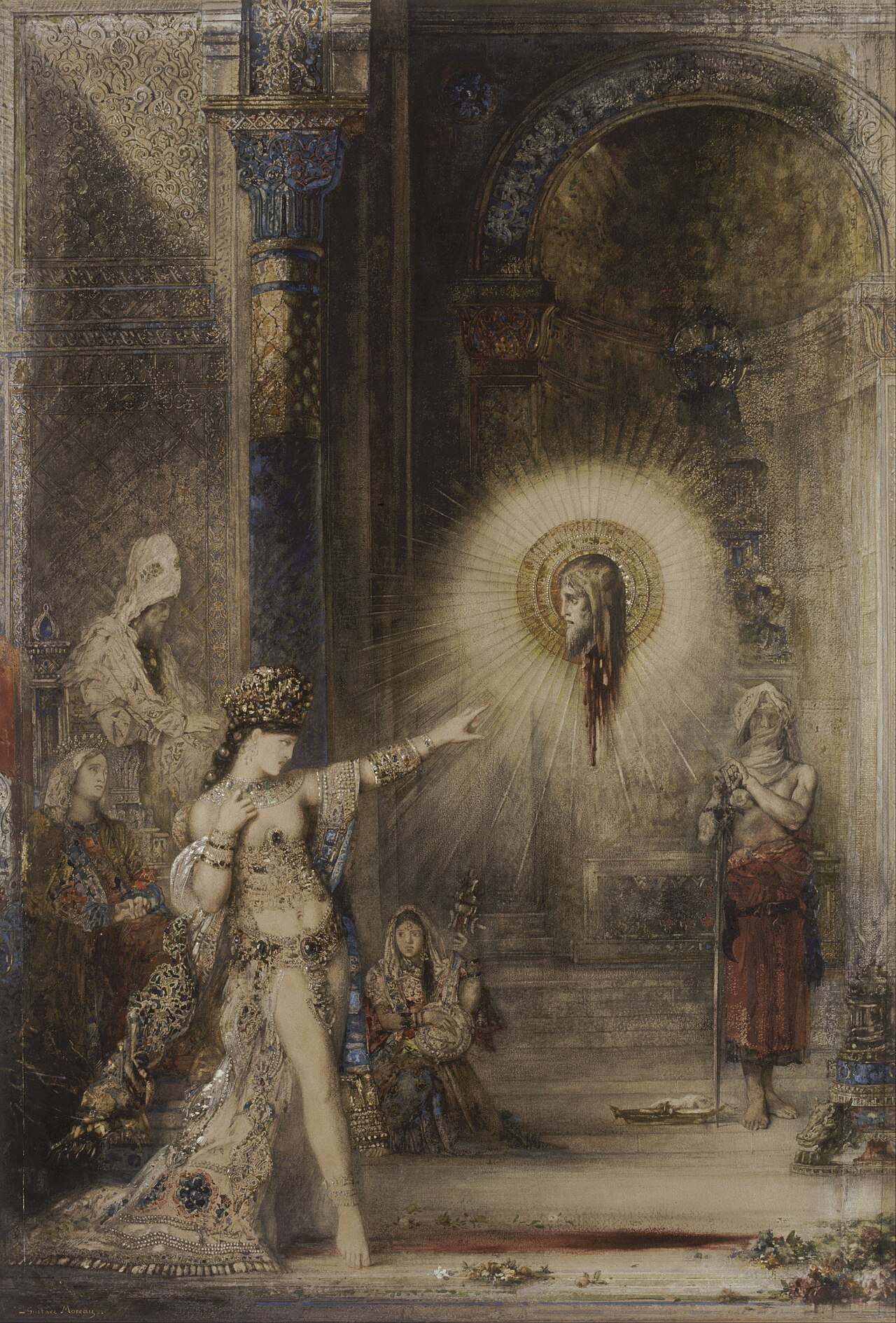


Completed in 1876, Moreau's The Apparition is the central image of French Haute Symbolism and the most famous of the artist's many Salomé works. Salomé stands centre, jeweled and tense, while the disembodied head of John the Baptist hovers in the air before her, ringed by golden light. The composition takes Flaubert's Salammbô and Mallarmé's poems as its lineage; J.-K. Huysmans devoted whole paragraphs of À rebours to this picture, anchoring it as decadent literature's favourite visual reference.
Moreau worked in dense, jeweled detail across a luminous architectural set. The Apparition was originally exhibited at the 1876 Salon and stayed an instant scandal-and-icon. Its visual register, gold, blood, jewels, the seer-figure looking at what shouldn't be there, established the iconographic vocabulary for an entire generation of Symbolist artists from Klimt to Khnopff.
The watercolor is held in the Musée d'Orsay, Paris. A larger oil version is at the Fogg Art Museum. For the Symbolist register the watercolor is the canonical artifact.