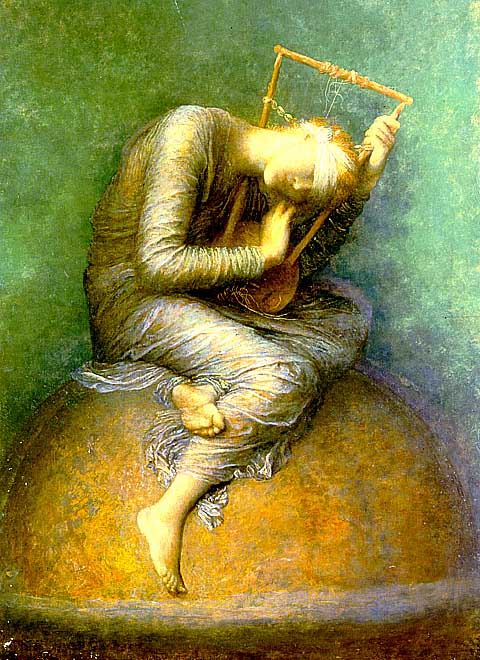


Completed in 1886, Watts's Hope is the great late-Victorian allegory and one of the most reproduced images of the nineteenth century. A blindfolded woman sits crouched on a globe, bent over a lyre with all but one string broken. She is bowed almost to her own knee, and yet she is still bent toward the instrument, listening for the single remaining string. The picture's title is held against its iconography in tension, what is offered as Hope is almost indistinguishable from Despair.
Watts painted at least three versions; the canonical one hangs in Tate Britain. Theodore Roosevelt kept a print; Martin Luther King Jr. preached on the image in 1959; Barack Obama referenced it in The Audacity of Hope. The painting has functioned as a touchstone across more than a century of political and religious thought precisely because it refuses easy consolation, its hope is the kind that survives almost everything else's failure.
The work stands at the threshold between Pre-Raphaelite spirituality and proper Symbolism. Watts's pared-down composition and allegorical purity prefigure the Continental Symbolist movement that would crystallise across the 1890s in Belgium, France, and Austria.