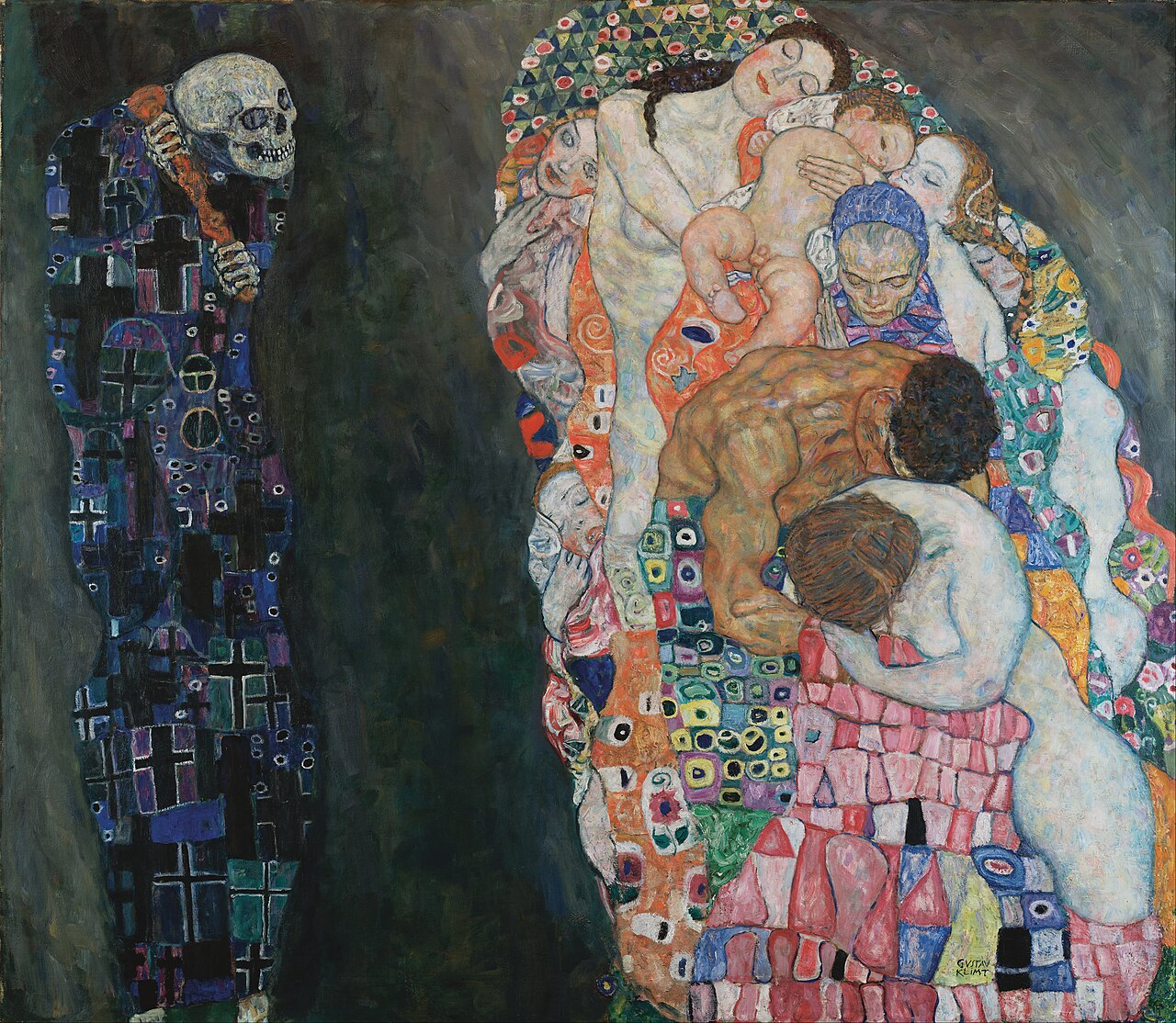


Klimt began Death and Life in 1908 and completed it around 1915. A robed figure of Death stands at the left side of the canvas, watching a sleeping cluster of human bodies, lovers, mothers, children, the old, on the right. The compositional split is absolute: one side a single figure in a skull-mask robe holding a club; the other side a sleeping pillar of intermingled life. Between them, only the canvas itself.
Klimt awarded himself a gold-medal first prize for this work at the 1911 Rome Esposizione Internazionale; he then continued to revise it for four more years. The version we see today is the result of those revisions. The picture's deep tessellated gold ground that characterised his earlier works is replaced by a darker, almost mossy field; the bodies become more massive and less ornamental. The painting marks Klimt's late shift from decorative-Symbolism toward a heavier, more sculptural register.
The work hangs in the Leopold Museum in Vienna. It is the most fully realised statement of the Klimt vocabulary that Egon Schiele and Oskar Kokoschka would inherit and transform into Austrian Expressionism.