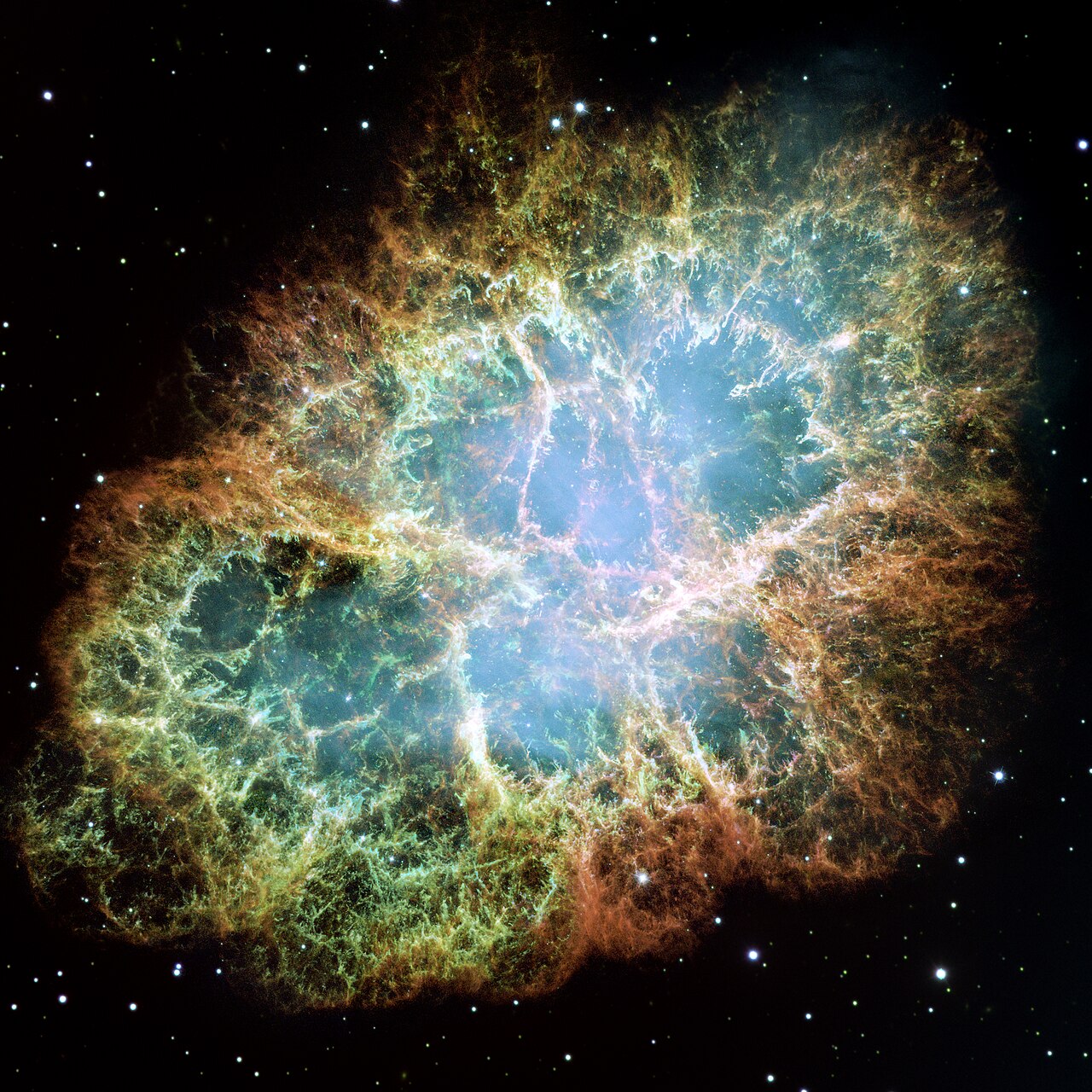


The Crab Nebula (M1, NGC 1952) is the remains of a supernova explosion observed by Chinese astronomers in 1054 CE. The supernova was bright enough to be visible in daylight for 23 days; Chinese, Japanese, and Arabic chronicles all recorded it. What we see today, almost a thousand years later, is the expanding cloud of debris ejected from the original star, illuminated by synchrotron radiation from the pulsar at the cloud's center.
This composite image combines data from the Hubble Space Telescope (visible-light) and the Chandra X-Ray Observatory (X-ray emissions). The filaments are gas from the original star's outer layers, glowing in the colors of their constituent elements: hydrogen red, oxygen blue-green, sulphur yellow. The pulsar at the center rotates 30 times per second, sweeping a beam of radio waves and X-rays across the solar system; the beam is what reaches Earth as a regular pulse.
The image is in the public domain under NASA / ESA release terms. The Crab Nebula is one of the most-studied objects in modern astronomy, its 1054 CE supernova is the only such event in human history that produced both a definite historical record and a still-observable remnant, making it a Rosetta stone for connecting astronomical theory to ancient astronomical observation.