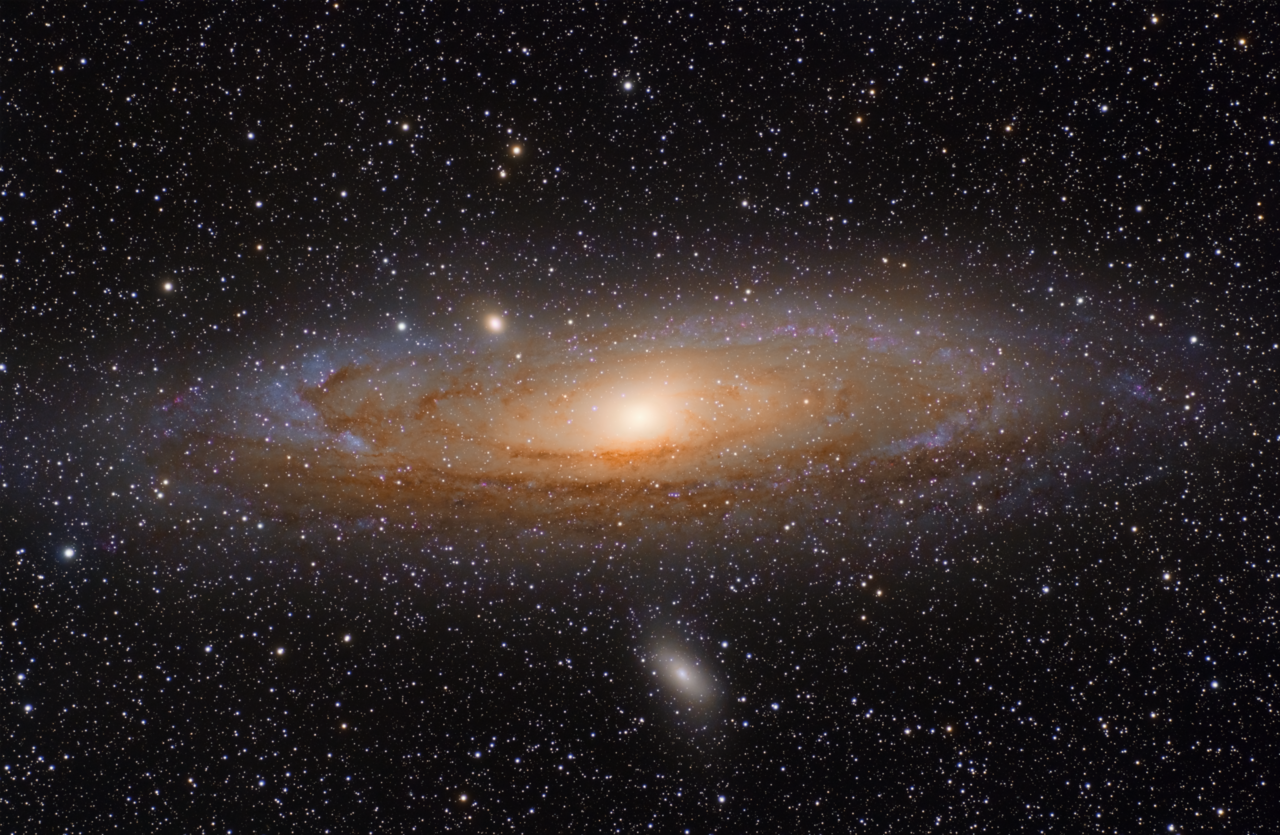


The Andromeda Galaxy is the most distant object visible to the unaided human eye. Under dark skies, away from city lights, it appears as a fuzzy oval patch in the constellation Andromeda, slightly elongated, slightly brighter at the centre. The light arriving at the eye left the galaxy two and a half million years ago. The Homo sapiens skull was not yet a finished design; the species had not appeared. The photons of M31 began their trip before humans existed and arrive at human retinas now, an evening at a time, having outlived their senders by orders of magnitude.
The galaxy was catalogued by the tenth-century Persian astronomer Abd al-Rahman al-Sufi, who described it in his Book of Fixed Stars as "a small cloud." Charles Messier listed it as M31 in 1764, mistaking it (as everyone then did) for a nebula within our own galaxy. The misunderstanding lasted until 1923, when Edwin Hubble at Mount Wilson photographed individual Cepheid variable stars within M31 and used their period-luminosity relationship to calculate their distance. The distance was so far that the Cepheids could not be inside the Milky Way. The conclusion was inescapable and overturned cosmology: the universe contains other galaxies; our galaxy is one of many; what had been called the Andromeda Nebula was actually the Andromeda Galaxy, a separate stellar system at distance comparable to the size of the visible universe as the early twentieth century imagined it.
The galaxy contains roughly one trillion stars (compared to the Milky Way's two to four hundred billion) and spans about two hundred and twenty thousand light-years across. It is approaching us at one hundred and ten kilometres per second. In approximately four and a half billion years it will collide with the Milky Way. Both galaxies will be deformed, will exchange stars, will pass partly through each other, and will eventually settle into a single larger elliptical galaxy that astronomers have provisionally named Milkomeda. The Sun and Earth will likely survive the merger but will be flung to a different orbital position within the new combined galaxy. By then the Sun will have evolved into a red giant and the Earth will not be habitable; the collision will be observable, in principle, only by whatever descendants of biological intelligence are around to observe it from somewhere else.
The image we have of Andromeda is the product of two and a half million years of light propagation plus several hours of photon collection in a digital camera. It depicts the galaxy as it was when humans had not yet evolved. The galaxy as it is now will be visible to telescopes two and a half million years from now, when we will likely no longer be here to point them. Andromeda is the largest single object visible from Earth, the most distant object the eye can resolve, and the surest available reminder that what we see of the universe is a record of what was, not of what is. Look up tonight, away from streetlights. You can see it. It is older than you are by a factor of one hundred thousand.