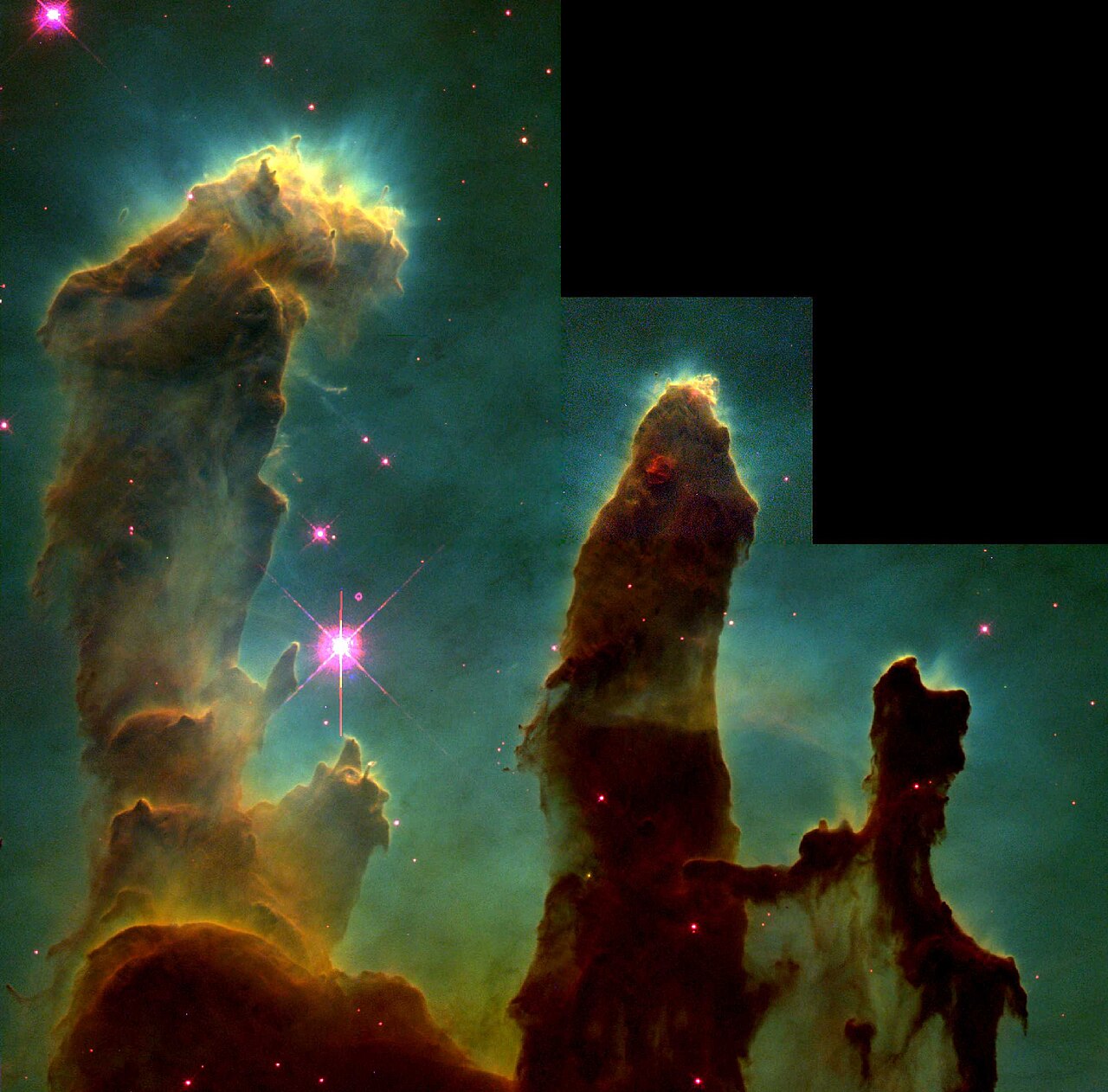


The image we have may be of something that no longer exists. Infrared observations from the Spitzer Space Telescope in 2007 suggested the three pillars of cold molecular hydrogen in the Eagle Nebula may have already been destroyed by a nearby supernova around six thousand years ago, the shockwave still travelling toward us. The Eagle Nebula is six and a half thousand light-years from Earth. If the destruction occurred, the wavefront carrying that information has not yet arrived; the destruction will not become visible from any telescope until somewhere in the next thousand years.
We habitually treat images of distant astronomical objects as observations of present states. The pillars are evidence to the contrary. The light that left the nebula six and a half millennia ago is the light Hubble photographed on the second of April, 1995, in a thirty-two-exposure composite assembled through filters tuned to the emission lines of hydrogen, oxygen, and sulphur. The composite was released in November 1995. Within twelve years we had reason to believe the pillars in the image were no longer there. Within a thousand years we will likely have evidence to confirm or refute that belief. The image will not change. The structure it depicts will resolve in deep time.
The largest pillar is four light-years tall, three times the distance from the Sun to its nearest stellar neighbour. The pillars are stellar nurseries: new stars are forming inside the densest knots of the hydrogen columns, while the radiation from already-born stars in the cluster slowly evaporates the pillars from outside. Stellar formation and stellar destruction in the same photograph, on the same physical structure, separated only by spatial position within the gas. Astronomy supplies few images this self-contained.
The 1995 release made the photograph one of the most widely reproduced images Hubble ever produced. It travelled into screensavers, into textbooks, into book covers and album sleeves. Its travel is not unrelated to its content. An image of structures forming and dissolving in the same frame, six thousand years out of date the day it was taken, was always going to find a long audience. We are, when we look at it, watching something already gone. The fact that we can see it at all is the picture's real subject.