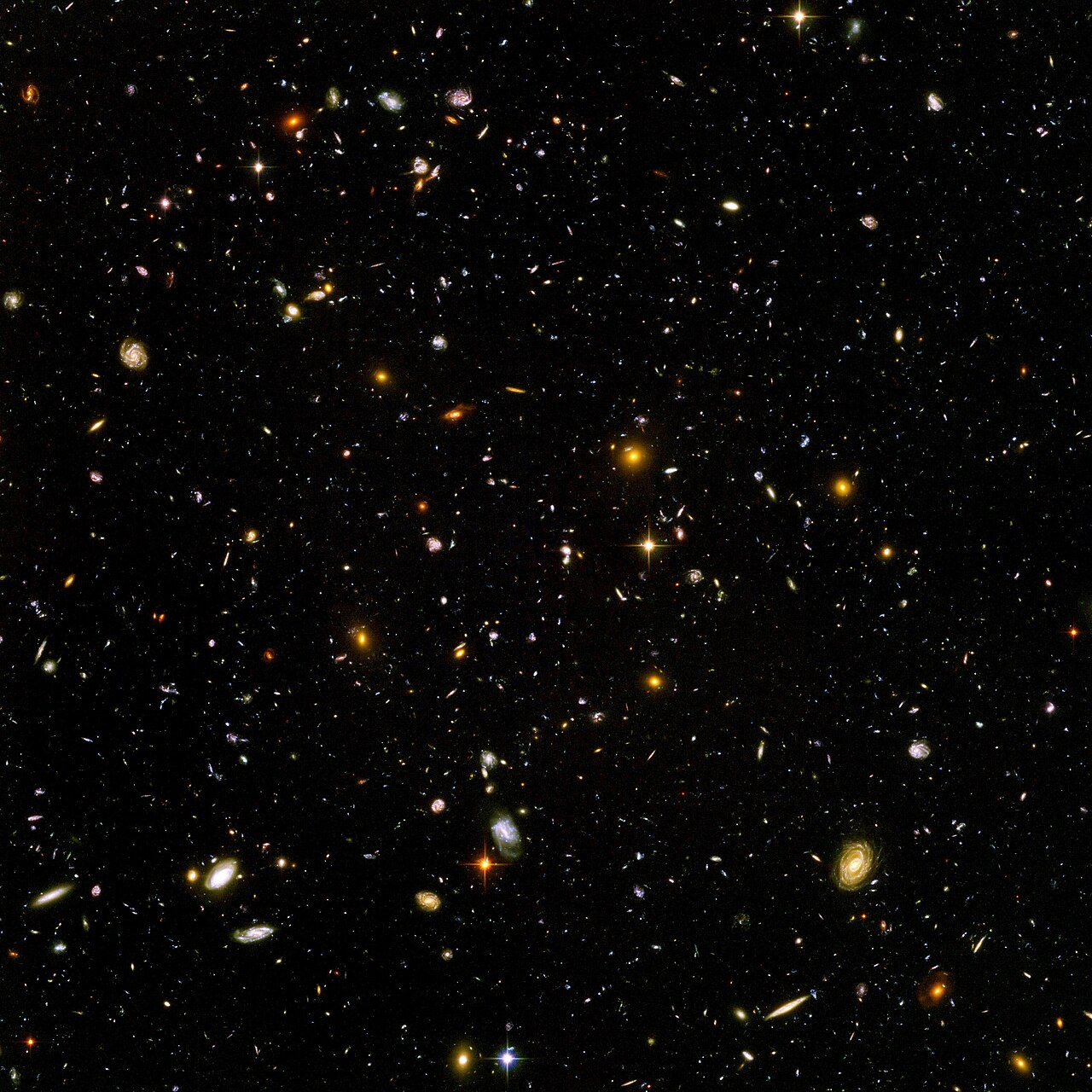



Released in 2004, the Hubble Ultra Deep Field is the deepest visible-light image of the universe ever taken at the time of its publication. A composite of 800 exposures totaling 11.3 days of telescope time pointed at a single tiny patch of sky near the constellation Fornax, a region chosen because it appeared almost entirely empty to ground-based telescopes. The image revealed roughly ten thousand galaxies in that single patch, including some of the most distant galaxies ever observed (redshifts beyond 12).
The exposure is a cosmological argument made visible: the universe is not finite at the limit of unaided vision; it is full of galaxies wherever you look long enough. Galaxies in the image span billions of years of cosmic time, the most distant appear as they were within a few hundred million years of the Big Bang. The image collapses depth and time into a single composition that has reshaped public understanding of cosmic scale since its release.
The image is in the public domain (NASA / ESA produced under US-government release terms; ESA released under their Hubble image archive). It remains the canonical visualization of the cosmological deep-field result and is the image most often used to introduce the question 'how big is the universe?' to non-specialist audiences.