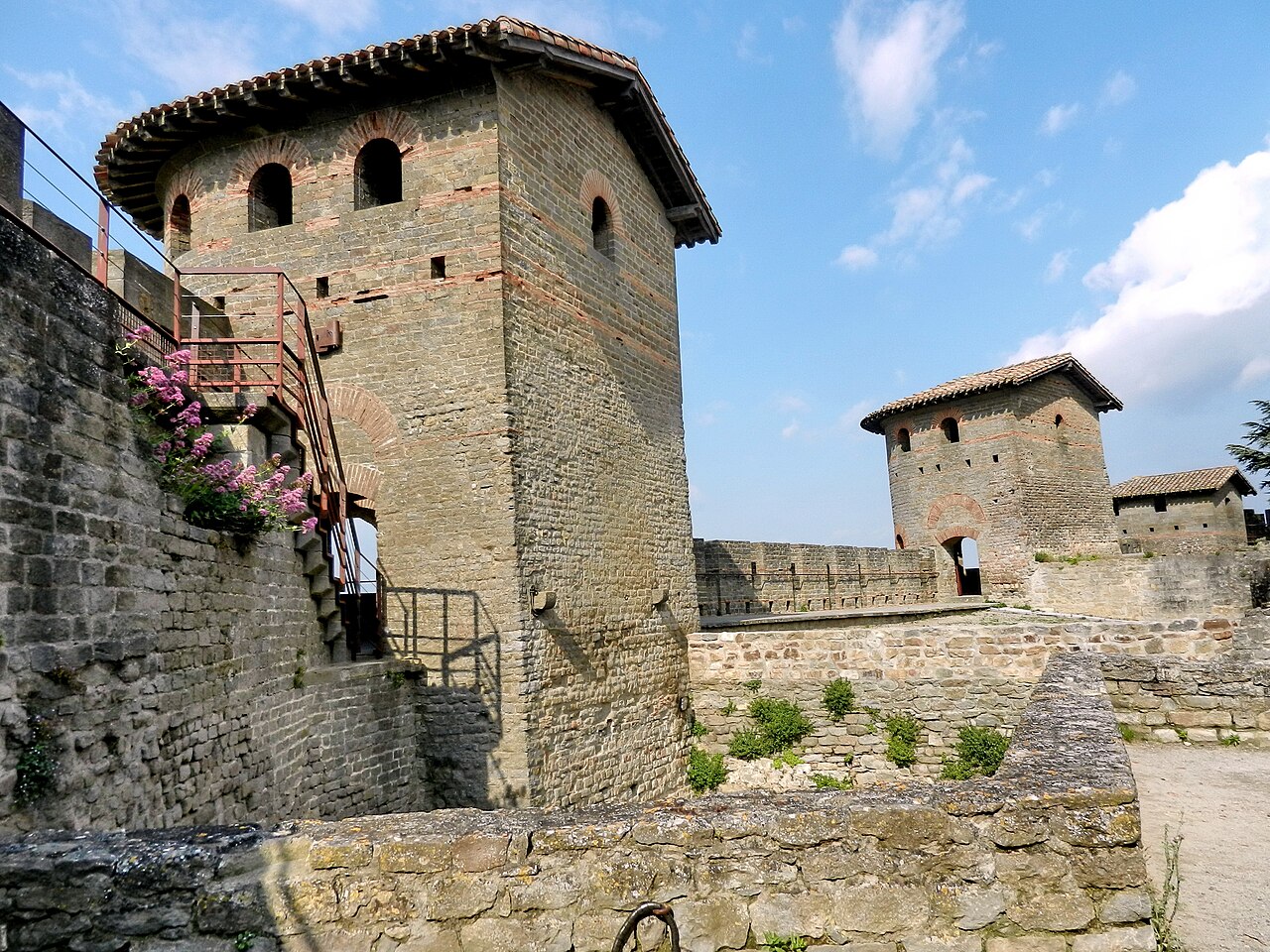



The Cité de Carcassonne is the largest intact medieval walled fortress in Europe. The walls began as a Gallo-Roman fortification in the 1st century CE, were expanded by the Visigoths after 460, fortified again under the Carolingians, and reached their canonical form between the 12th and 14th centuries as a frontier fortress of the French crown against Aragon. After Louis XIII annexed Roussillon in 1659, Carcassonne lost its strategic value and fell into a two-century decline that left the walls in poor but largely intact condition.
The Cité was famously restored in the second half of the nineteenth century by Eugène Viollet-le-Duc, the architect-restorer behind the restoration of Notre-Dame de Paris and the Château de Pierrefonds. Viollet-le-Duc's Carcassonne is one of the most influential and contested restoration projects in European preservation history, the conical slate roofs on the towers are nineteenth-century reconstructions rather than original; many historians have argued that Viollet-le-Duc reconstructed Carcassonne into a Romantic idealization of medieval fortification rather than a literal restoration of any single historical moment.
The fortress contains a double ring of walls (two kilometers of curtain wall, fifty-three towers), a central castle (Château Comtal), and the Basilica of Saints Nazarius and Celsus. The Cité is a UNESCO World Heritage Site since 1997 and one of the most-visited heritage monuments in southern France. The image of Carcassonne's silhouette has shaped the visual vocabulary of medieval fortification in European cultural memory more thoroughly than almost any single other structure.