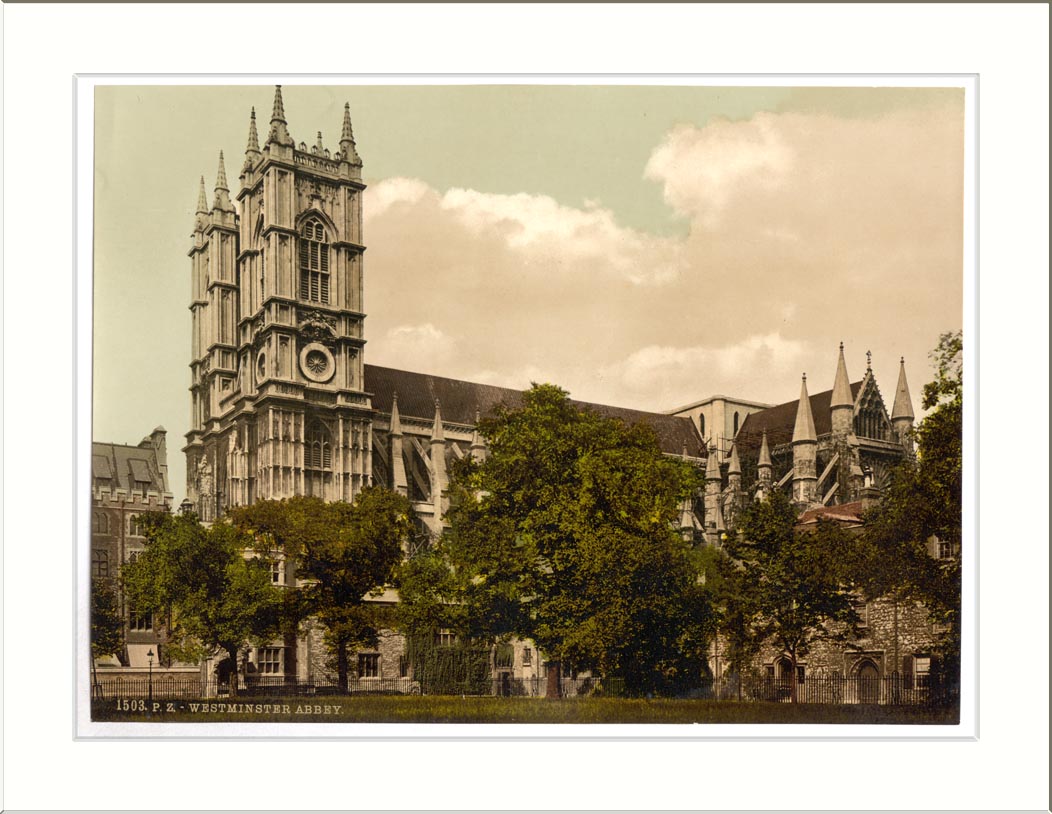


Westminster Abbey, the Royal Peculiar church on the north bank of the Thames in London, has been the coronation site of every English and British monarch since William the Conqueror in 1066. The current building was begun under Henry III in 1245 in the French Gothic style of the cathedrals at Reims and Amiens; the nave was completed under Henry Yevele in the late fourteenth century; the iconic west towers were added by Nicholas Hawksmoor in the eighteenth century to a design rooted in Christopher Wren's earlier proposals.
The Abbey holds the tombs of seventeen English monarchs from Edward the Confessor (the patron-saint founder of the original 1060s church) through George II, plus Poets' Corner (Chaucer, Dryden, Tennyson, Browning, Hardy, Kipling, Hughes, others); the graves of Newton, Darwin, Hawking; and the Tomb of the Unknown Warrior installed in 1920. It has been the venue for the marriages of Prince William and Catherine Middleton (2011), the funeral of Queen Elizabeth II (2022), and the coronation of King Charles III (2023).
The Abbey is a UNESCO World Heritage Site and one of the most visited church buildings in the world. Architecturally it sits at the intersection of French Rayonnant Gothic and English Perpendicular Gothic, the long sequence of clerestory windows is a marker of the latter tradition's late flowering.

Hagia Sophia
Anthemius of Tralles and Isidore of Miletus (architects)

Mont-Saint-Michel
Bishop Aubert of Avranches (708) and successors

Notre-Dame de Paris
Anonymous (medieval master masons, 1163-1345)
Cattedrale di Santa Maria del Fiore (Florence Duomo)
Filippo Brunelleschi (dome architect); Arnolfo di Cambio (original architect)