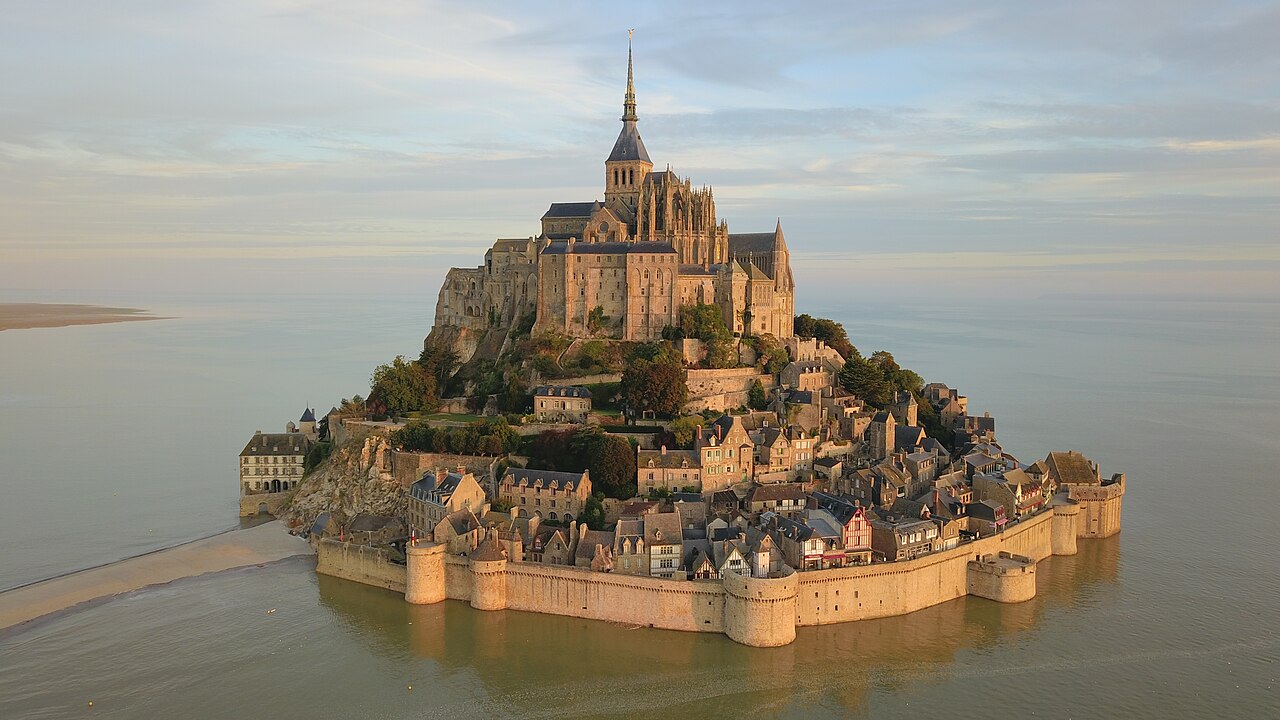


Mont-Saint-Michel is, before any other description, a problem in masonry. The granite outcrop rising from the tidal flats at the Normandy-Brittany border is eighty meters high. The abbey on top is twenty-five meters higher. The structural challenge of building stone walls and a Romanesque crypt directly on the irregular shape of a natural rock, then placing a Gothic choir with flying buttresses on top of those walls, then expecting the entire ensemble to survive twelve centuries of tides and storms, is the medieval engineering achievement the picturesque silhouette tends to obscure.
Bishop Aubert of Avranches built the first oratory in 708 after reporting three visions of the Archangel Michael instructing him to consecrate the rock. The Romanesque abbey followed in the eleventh century. The Gothic choir, with the flying buttresses anchored not to ground but to the masonry below them, was finished in the fifteenth. Each successive generation of builders had to inherit the structural assumptions of the generation before and find a way to extend them upward without bringing the whole thing down. The fact that they succeeded is the building's main argument for itself.
For most of its history the mount was an island only at high tide. A narrow strip of sand connected it to the mainland, crossed at risk by pilgrims who learned the tidal schedule the hard way. The currents in the bay are among the strongest in Europe; the difference between low and high water is up to fourteen meters. A causeway was built in 1879. By the late twentieth century the causeway was silting up the bay around the mount, choking the tidal system. France replaced it in 2014 with an elevated bridge that lets the sand return and the tide circle the mount as it did for the abbey's first thousand years. The contemporary fix preserves a medieval condition the modern fix had broken. Most heritage-engineering decisions go the other way.
The site was a UNESCO World Heritage listing in 1979 alongside the bay, the architectural ensemble, and the natural environment treated as a single object. It was, before that, a prison through the Revolution and the nineteenth century, a fishing village, a monastery again from 1969, and a tourist destination receiving roughly three million visitors a year. The site is busy enough now that the pre-dawn or post-sunset visits are the only times the silence the medieval pilgrims came for is recoverable.

Hagia Sophia
Anthemius of Tralles and Isidore of Miletus (architects)

Westminster Abbey
Anonymous (medieval master masons; Henry Yevele; Christopher Wren; Nicholas Hawksmoor)

Notre-Dame de Paris
Anonymous (medieval master masons, 1163-1345)
Cattedrale di Santa Maria del Fiore (Florence Duomo)
Filippo Brunelleschi (dome architect); Arnolfo di Cambio (original architect)