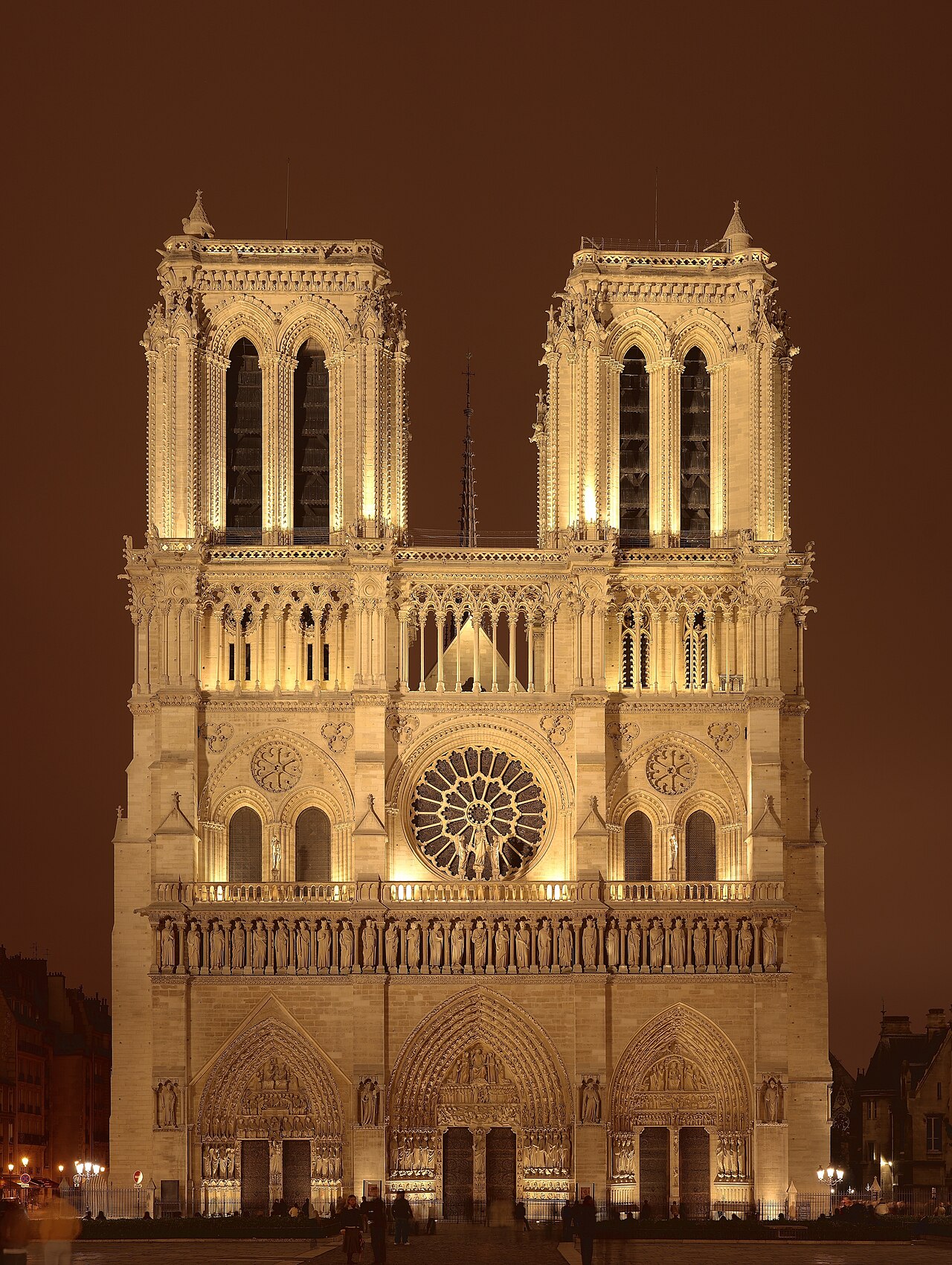



Construction of Notre-Dame de Paris began in 1163 under Bishop Maurice de Sully and was substantially complete by 1345. The cathedral stands on the Île de la Cité on the site of an earlier Romanesque church and, before that, a Gallo-Roman temple. It is among the earliest and most influential buildings of the French Gothic architectural tradition; the west facade, with its three deeply-set portals, rose window, and gallery of kings, is one of the most-reproduced architectural compositions in European visual culture.
The cathedral has been a continuous witness to French political and cultural history: it hosted the coronation of Henry VI of England as French king in 1431, the marriage of Mary Queen of Scots in 1558, Napoleon's self-coronation as Emperor in 1804, and the funerals of multiple French presidents. Victor Hugo's 1831 novel Notre-Dame de Paris (in English commonly The Hunchback of Notre-Dame) helped trigger the nineteenth-century French preservation movement and the cathedral's restoration by Viollet-le-Duc.
On 15 April 2019, a fire severely damaged the roof and spire. The current restoration was completed in December 2024 and the cathedral reopened. The west facade pictured here survived the fire largely intact; it remains the canonical photograph by which most readers picture Notre-Dame.

Hagia Sophia
Anthemius of Tralles and Isidore of Miletus (architects)

Mont-Saint-Michel
Bishop Aubert of Avranches (708) and successors

Westminster Abbey
Anonymous (medieval master masons; Henry Yevele; Christopher Wren; Nicholas Hawksmoor)
Cattedrale di Santa Maria del Fiore (Florence Duomo)
Filippo Brunelleschi (dome architect); Arnolfo di Cambio (original architect)