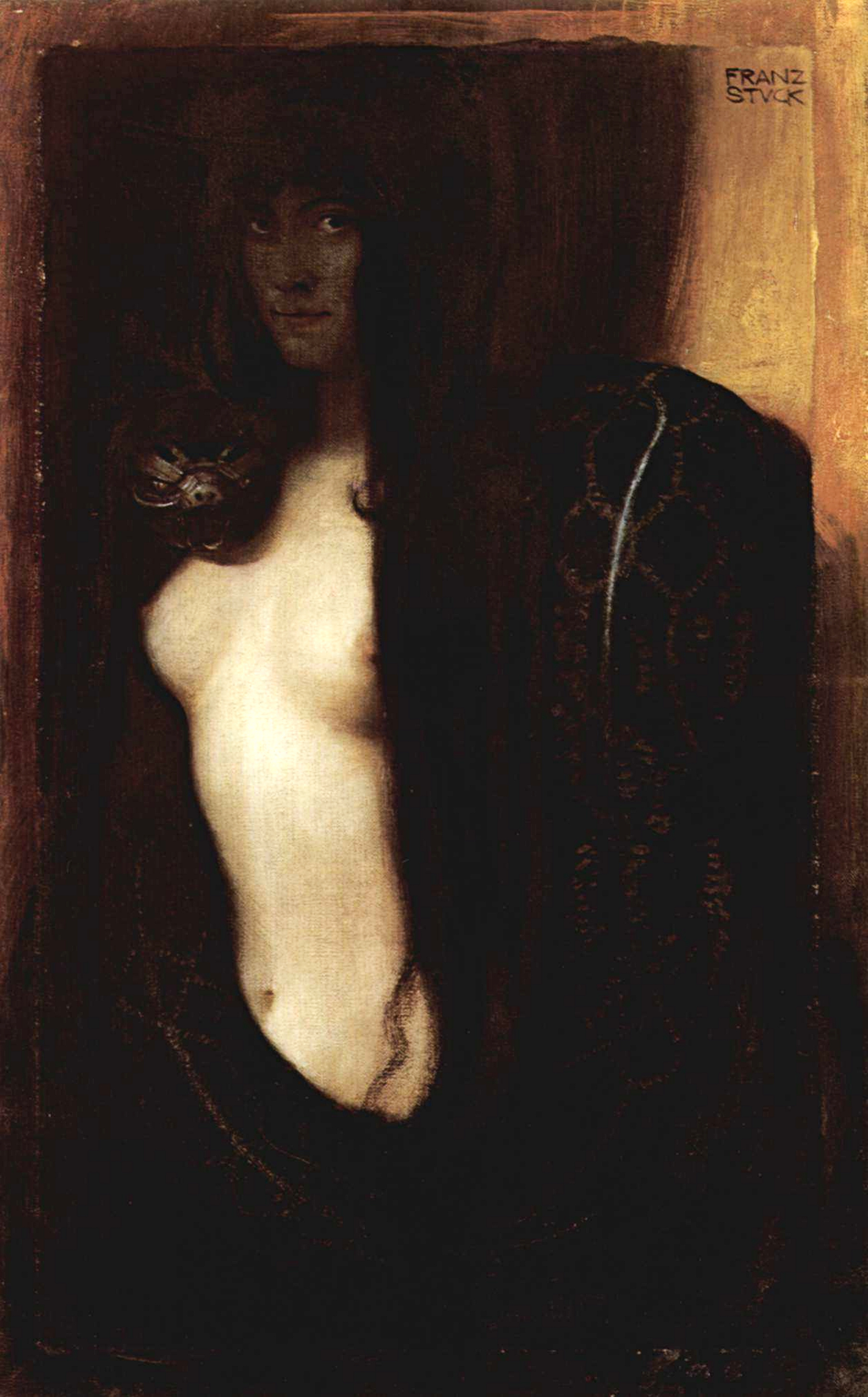


Franz von Stuck's Die Sünde (The Sin), first shown in Munich in 1893, is among the defining images of fin-de-siecle Symbolism. A nude woman emerges from near-black shadow, a massive serpent coiled around her shoulders and body, its head resting at her breast as it stares out at the viewer. Her own face is half-lost in darkness. The painting fuses the biblical serpent of the Fall with the period's obsession with the femme fatale, woman as seductive danger.
Stuck was a founder of the Munich Secession and one of the most successful German artists of his day. He painted several versions of the subject and framed them in heavy gilded surrounds of his own design, to heighten their idol-like presence. The work belongs to the same decadent current as Klimt, Khnopff, and Beardsley, where beauty, sin, and death are deliberately entangled.