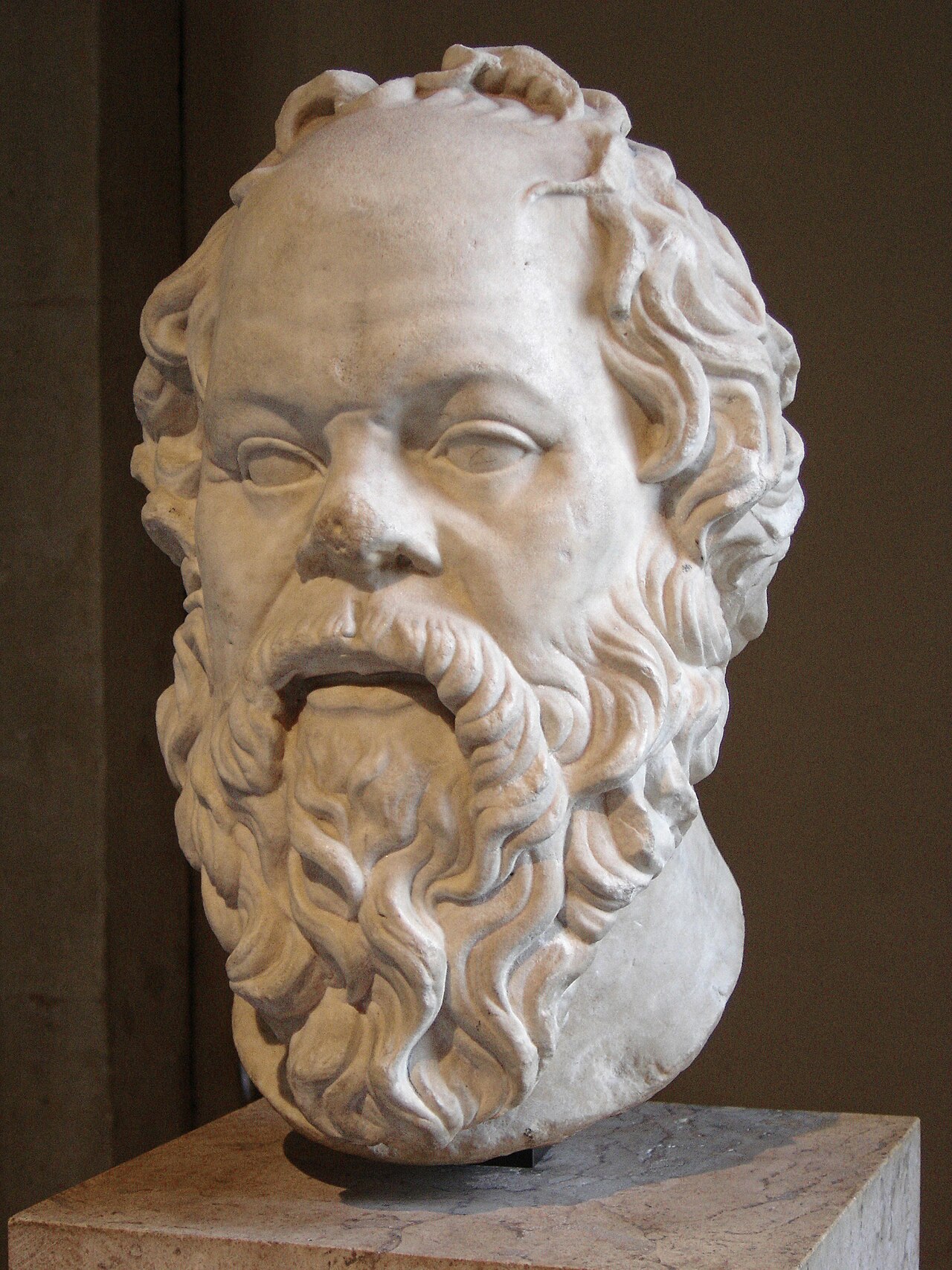


This Roman marble bust of Socrates held in the Louvre is one of the principal surviving portraits of the philosopher whose execution in 399 BCE has been treated as the founding martyrdom of Western philosophical practice. The portrait type, with its broad forehead, broken nose, snub features, and unkempt beard, follows the descriptions preserved in the Symposium and other Platonic dialogues where Socrates is repeatedly compared to a satyr or to the Silenus figures sold in marketplaces, hollowed out to reveal small statues of gods inside.
Socrates (c. 470 to 399 BCE) wrote nothing. His method of question-and-elenchus reaches us through the dialogues of Plato and Xenophon and through the comic satire of Aristophanes. The Apology, the Crito, and the Phaedo, three dialogues by Plato representing the trial, the refusal to escape prison, and the death by hemlock, established the canonical narrative of philosophical commitment to truth at the cost of life. The doctrine that the unexamined life is not worth living, articulated at his trial, is one of the foundational propositions of the entire European philosophical tradition.
The bust is in the Louvre collection in Paris (Ma 59). The Greek original from which the Roman marble derives is not preserved, but the consistency of the surviving Roman copies across the major European collections (Louvre, Capitoline, Naples, British Museum, Vatican) indicates that a single canonical statue, probably the work of Lysippos or a member of his workshop in the second half of the 4th century BCE, served as the type-model for the iconographic tradition.