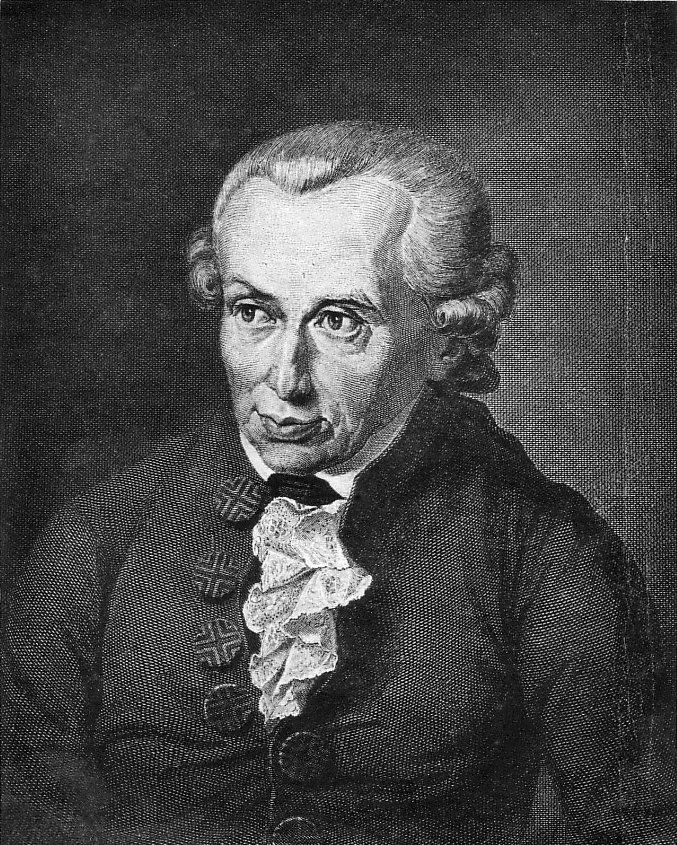


This portrait of Immanuel Kant in his Königsberg years (1724 to 1804) shows the philosopher in academic costume at the writing desk where he composed the three Critiques: the Critique of Pure Reason (1781), the Critique of Practical Reason (1788), and the Critique of the Power of Judgment (1790). Kant lived his entire adult life in Königsberg, never traveled more than 150 kilometers from the city of his birth, and famously kept a schedule so regular that the housewives of Königsberg were said to set their clocks by his afternoon walks. The constancy of his external life was the conditioning frame for one of the most ambitious philosophical systems ever attempted.
The Critical philosophy reorganized the central questions of metaphysics, ethics, and aesthetics around the proposition that the conditions of possibility of experience lie in the structure of the experiencing subject rather than in the world experienced. Space and time are forms of intuition; causality is a category of the understanding; the moral law is the categorical imperative grounded in the autonomy of practical reason. Every subsequent major figure in continental European philosophy from Hegel through Schopenhauer, Nietzsche, Husserl, Heidegger, and the analytic tradition since Frege has had to position himself in relation to Kant.
The portrait is one of several executed during the 1780s and 1790s when Kant's international fame was at its peak. The Critique of Pure Reason was greeted on first publication with incomprehension; by the time of the second edition (1787) it had become the central philosophical event in Europe. Kant's three Critiques and his late political writings (Perpetual Peace, the Metaphysics of Morals) are the canonical foundation of liberal political thought and of the German Idealist tradition that followed him.