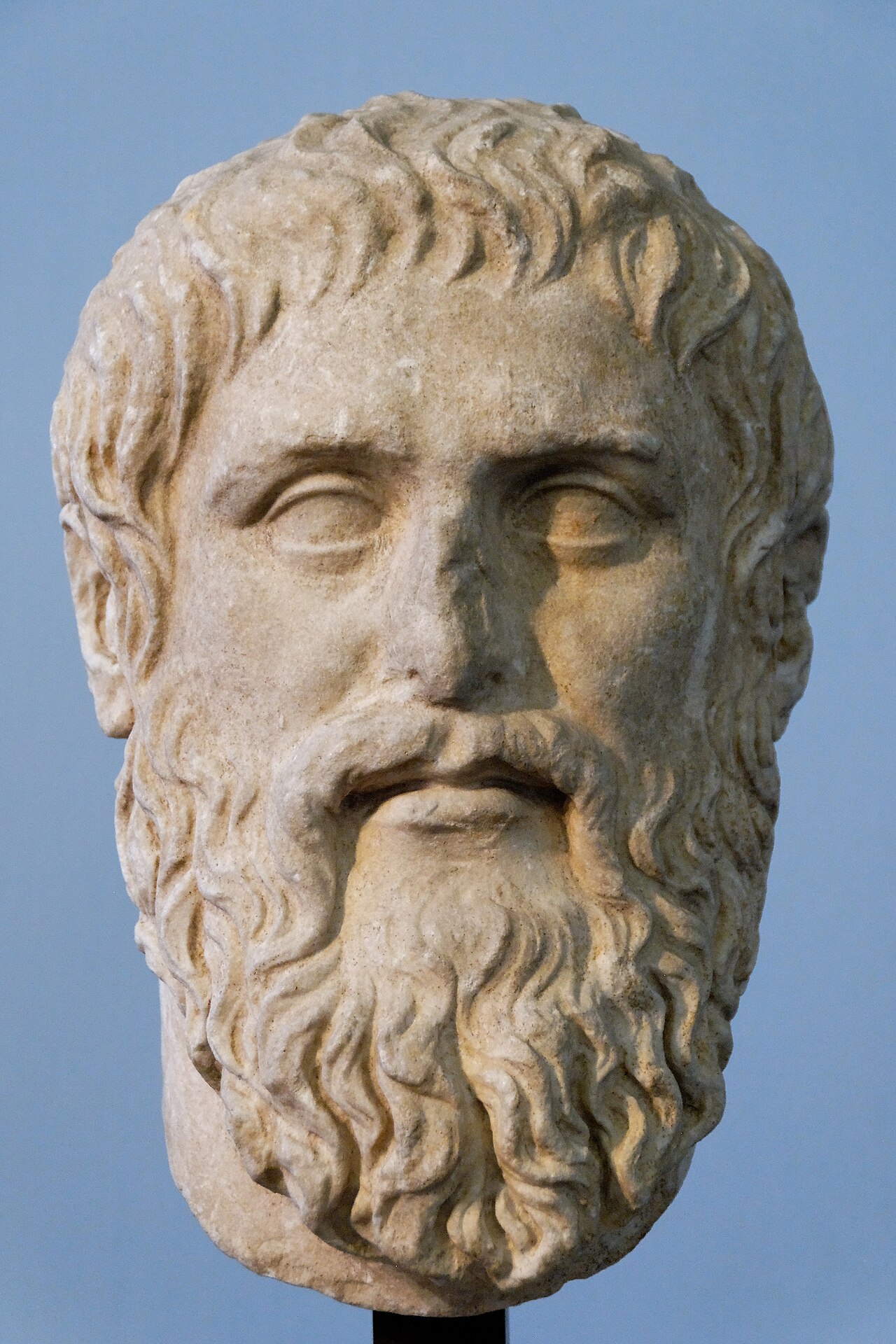



This marble bust of Plato held in the Capitoline Museums in Rome is the canonical portrait type of the founder of the Academy. The original was a bronze statue commissioned around 370 BCE by the Persian sympathizer Mithridates and executed by Silanion, the Athenian sculptor active in the second half of the fourth century BCE. The Capitoline marble is one of several Roman copies of that lost original, all of which descend from a single source and together establish what Plato looked like in the iconographic imagination of antiquity: bearded, sober, with the inward gaze of contemplative reason.
Plato (c. 428 to 348 BCE) is the author of approximately thirty-six surviving dialogues that constitute the founding corpus of Western philosophy. The Republic, the Symposium, the Phaedrus, the Phaedo, the Timaeus, the Sophist, and the Parmenides shaped almost every metaphysical, political, and aesthetic question taken up by subsequent European thought. Alfred North Whitehead's remark that the European philosophical tradition consists of a series of footnotes to Plato is hyperbolic but structurally accurate: the theory of Forms, the tripartite soul, the analogy of the cave, the philosopher-king, the doctrine of recollection, the critique of imitation, and the metaphysics of the Good all originate here.
The bust pictured is at the Centrale Montemartini, the secondary site of the Capitoline collection in a converted Roman power station. The Capitoline collections of Roman copies of Greek portrait sculpture are one of the foundational source sets for the iconography of ancient philosophy: most of the philosopher portraits reproduced in Renaissance and modern European visual culture trace their lineage to Roman copies of this kind.