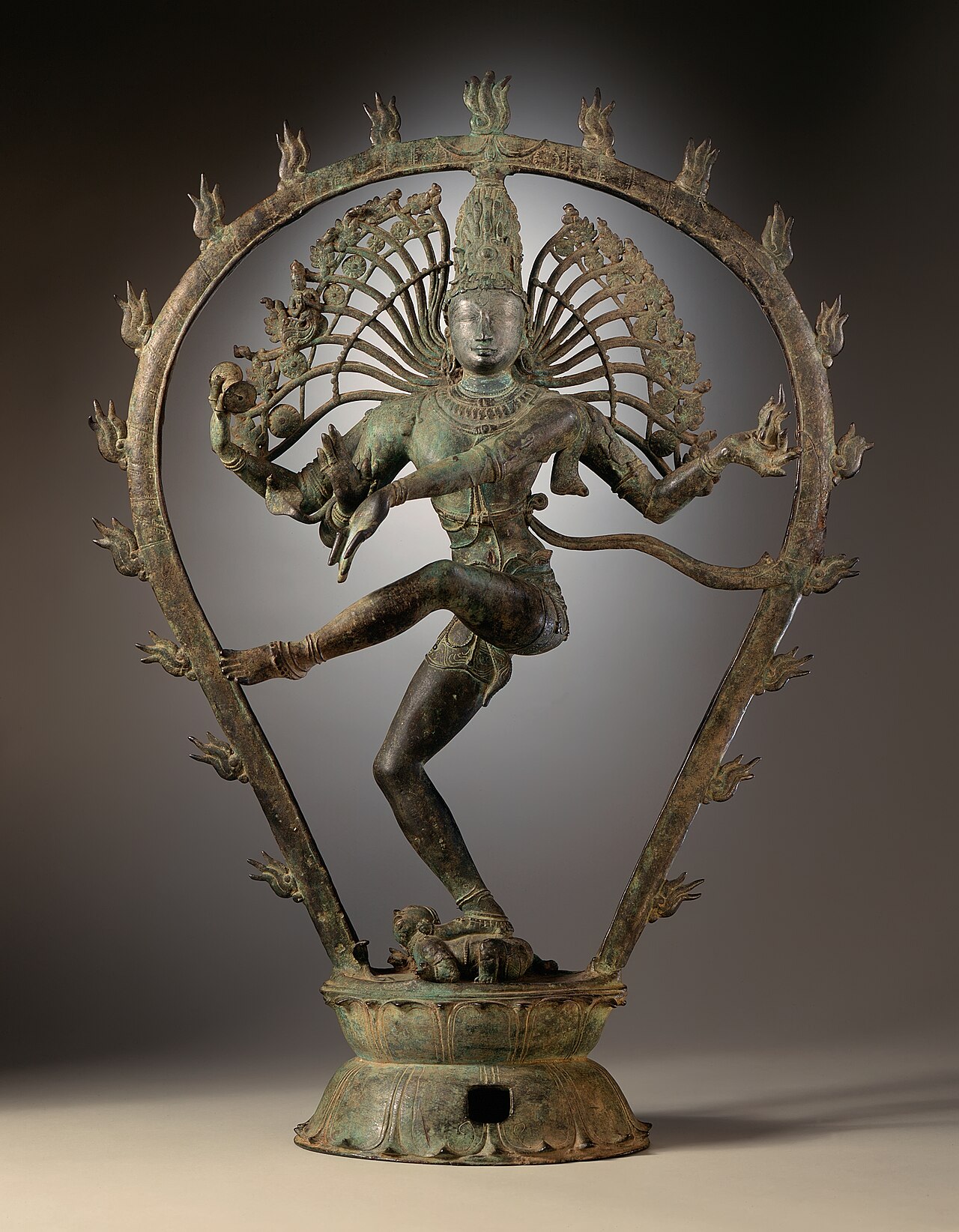


This bronze figure of Shiva as Nataraja, the Lord of the Dance, is one of the canonical artifacts of Hindu metaphysics and the single most-reproduced image of South Indian Chola-period sculpture. Shiva dances within a ring of flame (the prabhamandala), one foot raised, the other crushing the dwarf Apasmara who personifies ignorance. His four arms hold the drum of creation, the flame of destruction, the gesture of protection (abhaya mudra), and a downward-pointing hand directing the viewer to his raised foot, the foot of liberation.
The Chola bronzes of South India (9th-13th centuries CE) are made through the lost-wax (cire perdue) technique. The Nataraja iconography reached its canonical form under the Chola court during the reign of Rajaraja I (985-1014 CE). Bronzes of this type were processional images carried in temple festivals, designed to be seen in three dimensions, illuminated by oil lamps, in continuous motion.
The image's philosophical content is dense. The dance is the simultaneous creation, preservation, and destruction of the universe; the ring of flame is the perpetual cosmic cycle; the figure expresses Shaivite Tantric metaphysics, that consciousness and energy (Shiva and Shakti) generate everything else. The Nataraja is so foundational that CERN installed a replica outside its particle physics laboratory in Geneva as a tribute to the symmetry between cosmic dance and quantum field theory.