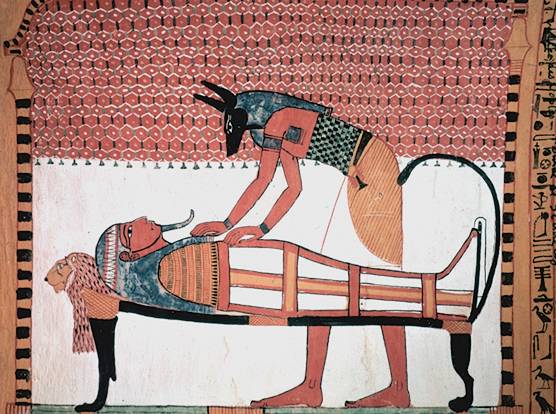


Painted on the wall of the tomb of Sennedjem (TT1) in Deir el-Medina around the 19th Dynasty (c. 1295-1213 BCE), this scene shows the jackal-headed god Anubis attending Sennedjem's mummified body on a lion-headed funerary bier. Anubis bends over the wrapped figure with a posture of professional attention; the iconography is canonical for the embalming and weighing-of-the-heart phase of the Egyptian afterlife journey.
Sennedjem was a 'Servant in the Place of Truth', one of the artisans who worked on the royal tombs in the Valley of the Kings under Pharaohs Seti I and Ramses II. His own tomb was discovered intact in 1886 with most of its painted decoration preserved in extraordinary condition. The Anubis scene is one of the most reproduced tomb paintings from the entire Egyptian corpus.
The wall painting remains in the original tomb (TT1) at Deir el-Medina, near modern Luxor. The image is also widely reproduced in museum catalogues, school textbooks, and the visual vocabulary of Egyptian-mythology popular reference; for most non-specialist readers, this is the image they picture when they hear 'Anubis weighing the heart.'