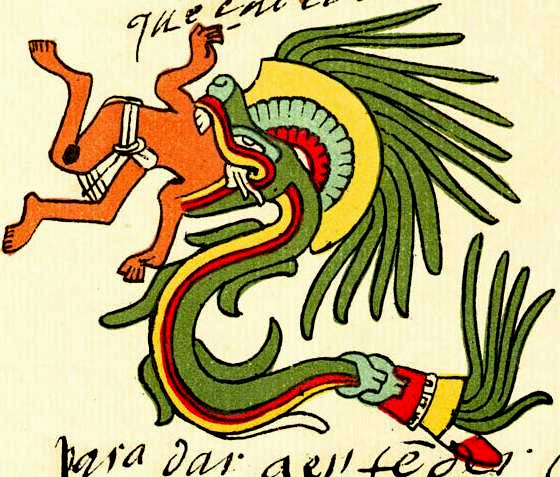



This illustration of Quetzalcoatl, the Feathered Serpent god of wind, knowledge, and creation, comes from the Codex Telleriano-Remensis, a Nahua-Spanish manuscript compiled in central Mexico in the early 1560s, three decades after the Spanish conquest. The codex is one of the most important surviving documents of post-conquest Mesoamerican iconography, produced by Nahua scribes working under the supervision of Dominican friars to document the religious and historical traditions of the Mexica (Aztec) civilization before they were fully suppressed.
Quetzalcoatl is one of the principal deities of the Mesoamerican pantheon, attested across Olmec, Teotihuacan, Toltec, Maya, and Mexica iconography from approximately 800 BCE through the conquest era. He is a creator god, a wind god, and the patron deity of priesthood and writing. The Mexica believed that Quetzalcoatl had departed eastward across the sea and would return, a prophecy Hernán Cortés exploited in the 1519-1521 conquest by allowing reports of his arrival to be interpreted within that mythological frame.
The codex is held at the Bibliothèque nationale de France in Paris (named for Charles Maurice Le Tellier, archbishop of Reims, who acquired it in the 18th century). It is among the small group of Pre-Columbian and immediately-post-conquest manuscripts that escaped the systematic Spanish destruction of indigenous American religious documents, a survival without which the iconography of Mesoamerican religion would be very substantially less documented.