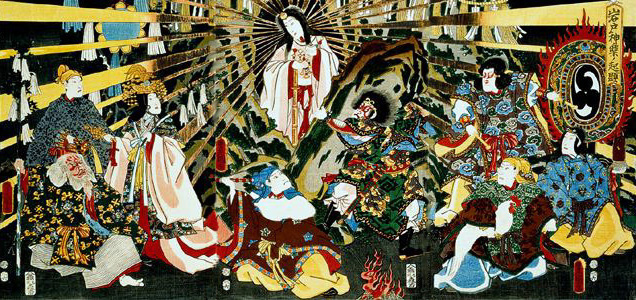


This Meiji-period woodblock print depicts one of the foundational scenes of Japanese mythology: Amaterasu-Omikami, the sun goddess, emerging from the cave (Ama-no-Iwato) where she had hidden herself after a dispute with her brother Susanoo. The other kami stand outside in supplication; the goddess Ame-no-Uzume dances on an overturned tub; Tajikarao, the strong-armed god, prepares to pull the rock away. The myth is the central foundational episode of the Kojiki and Nihon Shoki, the two oldest extant Japanese chronicles, compiled in 712 and 720 CE respectively.
Amaterasu is the imperial ancestor in Japanese state mythology. The Japanese imperial line traces its descent from her through her grandson Ninigi-no-Mikoto who descended to Japan; the Yata-no-Kagami mirror enshrined at the Ise Grand Shrine is the physical relic she gave to her descendants. Throughout the late nineteenth and early twentieth centuries the Meiji state systematized Amaterasu's mythological role into State Shinto, the official religion that would underwrite Japanese imperial ideology until 1945.
This woodblock print is among the many Meiji-era reproductions of classical Shinto mythology that circulated as state-sponsored visual education. The cave-emergence scene is the single most-illustrated episode of the Japanese mythological corpus across thirteen centuries of art, comparable in cultural anchoring to the Annunciation in Western European Christian iconography.