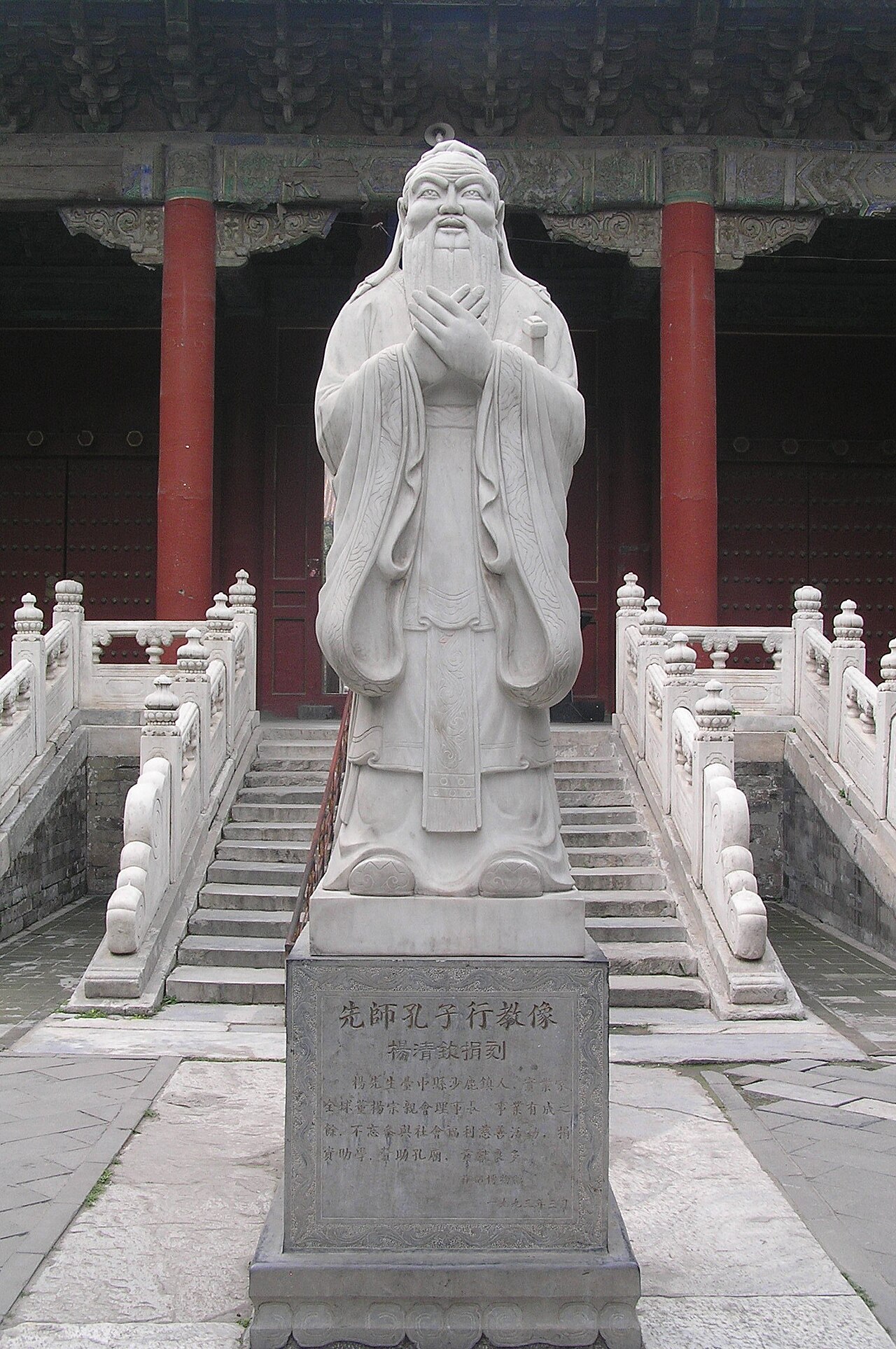


This bronze statue of Confucius, standing at the Confucius Temple, depicts the philosopher in the canonical scholar's robes with hands folded in the traditional gesture of greeting and reverence. The iconography is conventional across the global network of Confucius Temples, over two thousand are recorded in China, Korea, Vietnam, Japan, and across the Chinese diaspora, and dates as a visual tradition to the Han dynasty consolidation of Confucian state-philosophy around the second century BCE.
Confucius (Kong Qiu, conventionally 551-479 BCE) is the most influential philosopher of the East Asian tradition. The body of teaching preserved in the Analects (Lunyu) was compiled by his disciples and disciples' disciples over the centuries following his death. Confucian ethical philosophy, emphasizing ritual, filial piety, the cultivation of moral character through study, the ruler's responsibility to govern by virtue, became the foundational framework of Chinese imperial administration from the Han dynasty forward and influenced Korea, Japan, and Vietnam for two thousand years.
The statue is one of many at the Confucius Temple in Qufu, Confucius's birthplace, and at related Temples worldwide. Confucius sits in the philosophical canon alongside Aristotle, the Buddha, and Lao Tzu as one of the small group of pre-Common-Era figures whose thinking still anchors major contemporary traditions.