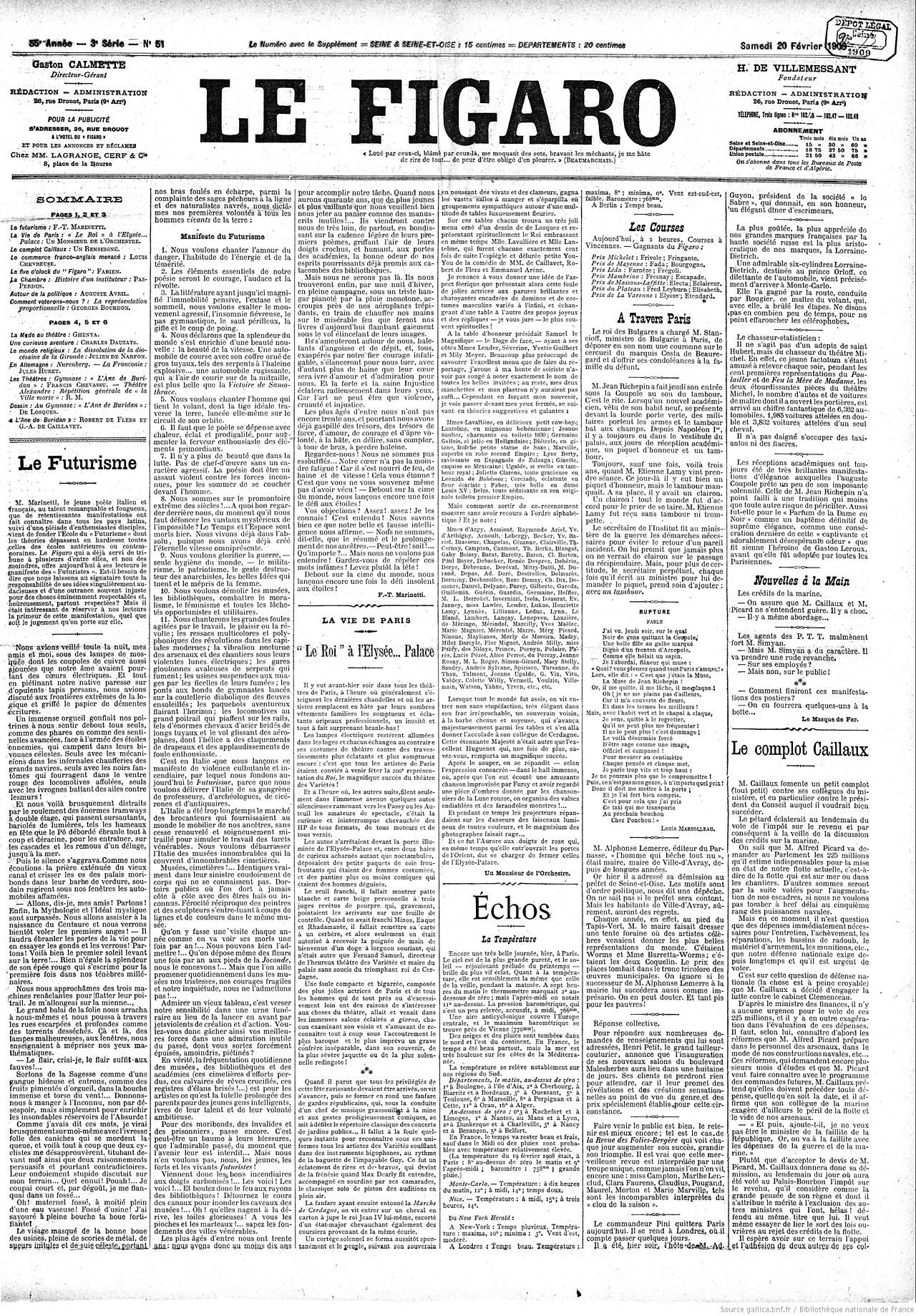


The Manifesto of Futurism was published as the front page of Le Figaro on 20 February 1909, written by the Italian poet and editor Filippo Tommaso Marinetti. The eleven numbered points of the manifesto declared the founding programme of the Futurist movement: a celebration of speed, machinery, violence, youth, war, and a complete repudiation of museums, libraries, and academies. Point 9: 'We will glorify war, the only cure for the world, militarism, patriotism, the destructive gesture of freedom-bringers, beautiful ideas worth dying for, and scorn for woman.' Point 10: 'We want to demolish museums and libraries.'
Marinetti's manifesto became the founding document of the first self-consciously avant-garde art movement of the twentieth century. Futurism produced manifestos at an unprecedented rate across the following years, manifestos of painting, sculpture, music, architecture, theatre, cinema, even cuisine, each one extending the original programme into a new domain. Umberto Boccioni's sculpture Unique Forms of Continuity in Space (1913) and Giacomo Balla's Dynamism of a Dog on a Leash (1912) are the canonical visual artifacts of the movement.
The 1909 Manifesto's celebration of war and rejection of cultural tradition has remained politically contested. Marinetti himself supported Italian intervention in the First World War and later joined Mussolini's Fascist Party in 1919. The manifesto is the founding document of avant-garde polemic and the model that Dada, Surrealism, Situationism, and most subsequent twentieth-century movements followed. Le Figaro's 20 February 1909 issue is held in multiple national newspaper archives.