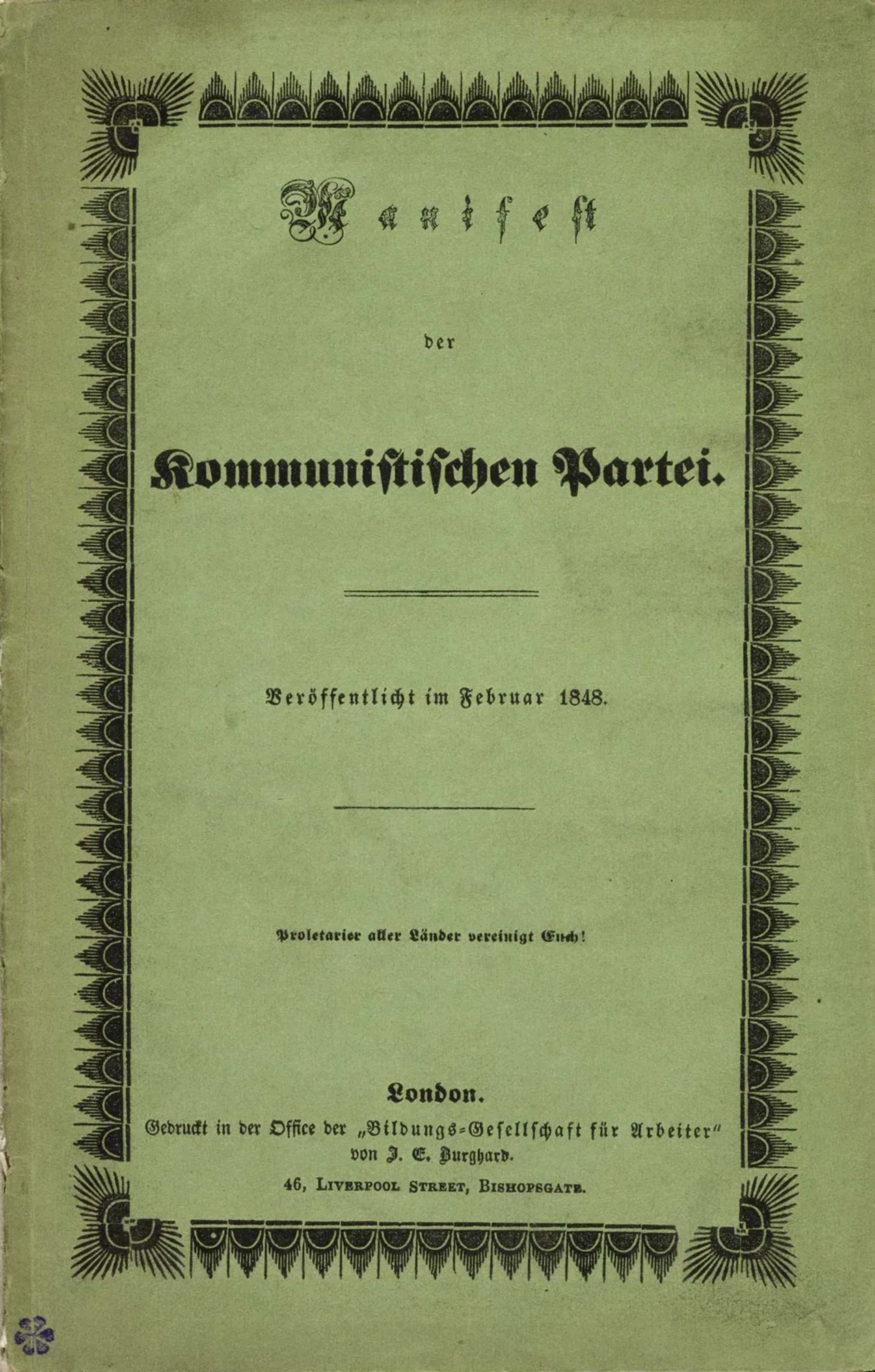


The Manifesto was commissioned in 1847 by the Communist League, a small international workers' organisation that had grown out of the League of the Just and that needed a programmatic statement to distinguish itself from competing socialist tendencies. Marx and Engels wrote it over the winter of 1847-1848. Engels produced the first drafts in catechism form (question-and-answer, a format borrowed from the religious literature both authors had been raised on); Marx restructured the material into the continuous prose of the published text. It was printed in London in February 1848, three weeks before the February Revolution overthrew Louis-Philippe in Paris and set off the wave of revolts that swept Central Europe that year. The timing was coincidental, but it shaped the text's reception: the Manifesto arrived as the year's political crisis was beginning, not in advance of it.
The pamphlet is short. The original German edition runs twenty-three small pages. It opens with the famous spectre line, "Ein Gespenst geht um in Europa, das Gespenst des Kommunismus," a spectre is haunting Europe, the spectre of Communism, and closes with the equally famous rallying cry, "Proletarier aller Länder, vereinigt euch!," workers of all countries, unite. Between these two sentences Marx and Engels compress what they argue is the entire historical motion of class society: from ancient slave economies through feudalism through bourgeois capitalism to the proletarian revolution they predicted was imminent. The argument is dense, fast, and rhetorical. The Manifesto is not a piece of theory. It is the political call to action of a theory developed elsewhere (in Marx's 1844 economic-philosophical manuscripts, in the German Ideology of 1846, eventually in Capital from 1867 onward), compressed for circulation.
A note on inclusion. The Manifesto is included not as an endorsement of its political programme; the platform's purpose statements (a curated territory for art and literature, organised around seven priorities including Aristocracy of mind and art) are not Marxist. The Manifesto is included because it is one of the founding documents of modern political rhetoric, because it is impossible to understand 175 years of European intellectual history without reading it, and because the platform's curatorial position requires that the major manifestos of the modern period be available, taken seriously, and engaged with critically, not removed from view because the conclusions they reach are politically uncongenial.
The Manifesto is now the most-translated political text after the Bible, with editions in over two hundred languages. The original 1848 first-edition pamphlets are exceedingly rare; a copy sold at Sotheby's London in 2015 for £45,000. The text is freely available through Project Gutenberg in multiple languages. A serious reader should encounter it whole at least once, ideally in the German original or a careful English translation, rather than in the quoted fragments that circulate in political discourse.