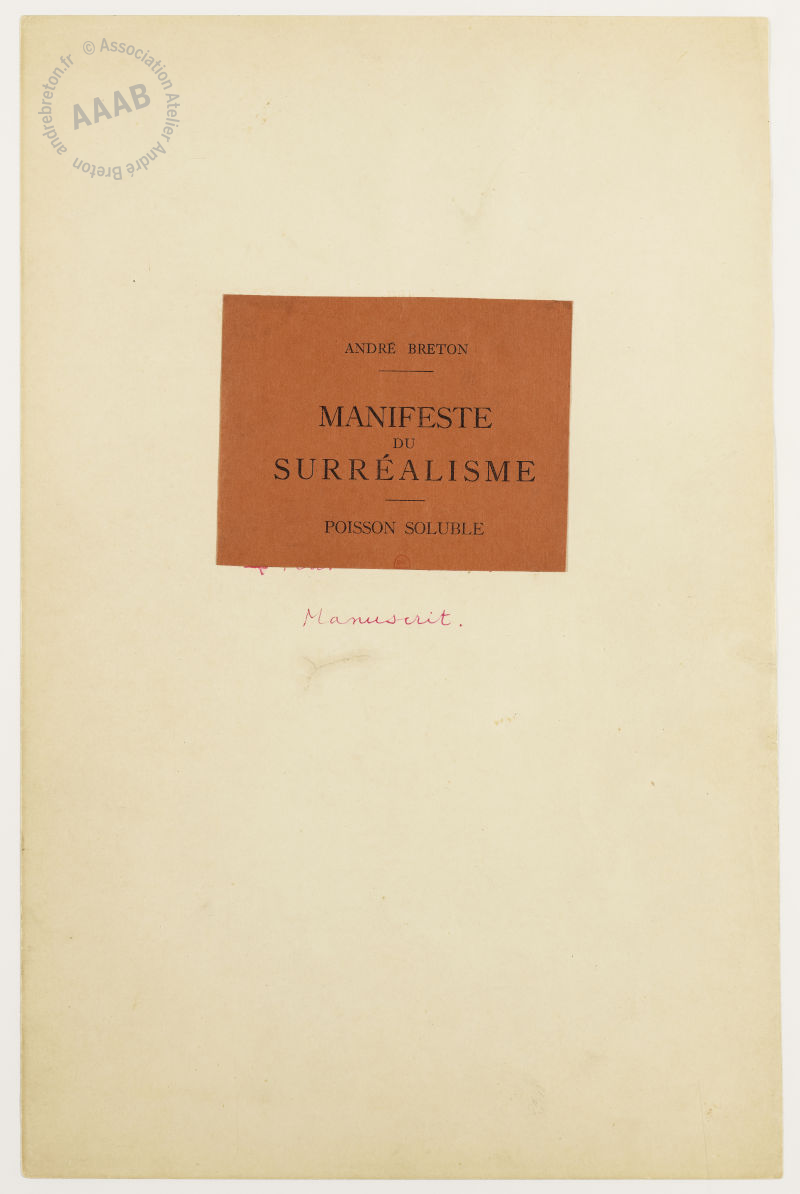


Breton published the Manifesto of Surrealism in October 1924, three years after the dissolution of the Paris Dada group from which Surrealism partially emerged. He was twenty-eight. The Manifesto is short (the first edition is roughly seventy pages), written in dense paragraphs of expansive French prose, and structured less as a programmatic statement than as a declaration of what Breton's circle had decided to do next. The famous definition arrives in the third quarter of the text: "SURRÉALISME, n. m. Automatisme psychique pur, par lequel on se propose d'exprimer, soit verbalement, soit par écrit, soit de toute autre manière, le fonctionnement réel de la pensée." Surrealism, masculine noun: pure psychic automatism, by which one proposes to express, verbally or in writing or in any other manner, the actual functioning of thought.
The definition is a forgery in a specific sense. Breton presented it as a dictionary entry, in the form of a dictionary entry, with the grammatical labelling (n. m., masculine noun) and the formal abstract definition. This was a deliberate aggression. The dictionary form belongs to the authoritative ordering of meaning that Surrealism was explicitly opposed to. Breton's gesture was to seize the form and use it to legitimise the new movement on its own terms: Surrealism is a noun, masculine, with this definition, and the definition is now official because Breton has just made it so. The text accomplishes its own founding act in the form of an entry in a dictionary that does not yet exist.
The argument of the Manifesto is for the supremacy of dreams, free association, and the unconscious over the rational ordering of reality that the text calls "realism" and treats with contempt. Breton draws on the early Freud (the Interpretation of Dreams was twenty-four years old when the Manifesto appeared), on Lautréamont ("as beautiful as the chance encounter on a dissecting table of a sewing machine and an umbrella"), on Apollinaire (who had coined the word surréalisme in 1917), on Reverdy. He provides examples of automatic writing and recipes for producing more. The text ends with a list of writers, both living and dead, whom Breton elects to the surrealist canon. The dead are included without their consent: Swift, Sade, Baudelaire, Rimbaud, Poe. Breton has confiscated them, made them surrealist by retrospective acquisition. The act would be repeated by every later avant-garde with a manifesto to issue.
The Manifesto of Surrealism is one of the most consequential aesthetic documents of the twentieth century. Surrealism reshaped poetry, painting, film, photography, and political thought across the next four decades, with branches in Brussels, Prague, Belgrade, Mexico City, Tokyo, and Cairo. Breton issued a Second Manifesto in 1930 (in which he excommunicated about half the original signatories) and continued to direct the movement until his death in 1966. The Manifesto's voice (declarative, definitional, accumulative) is the voice almost every later artistic manifesto in the twentieth century would borrow. The form was Breton's; the dictionary entry was his founding gesture; the gesture has had a hundred-year afterlife.