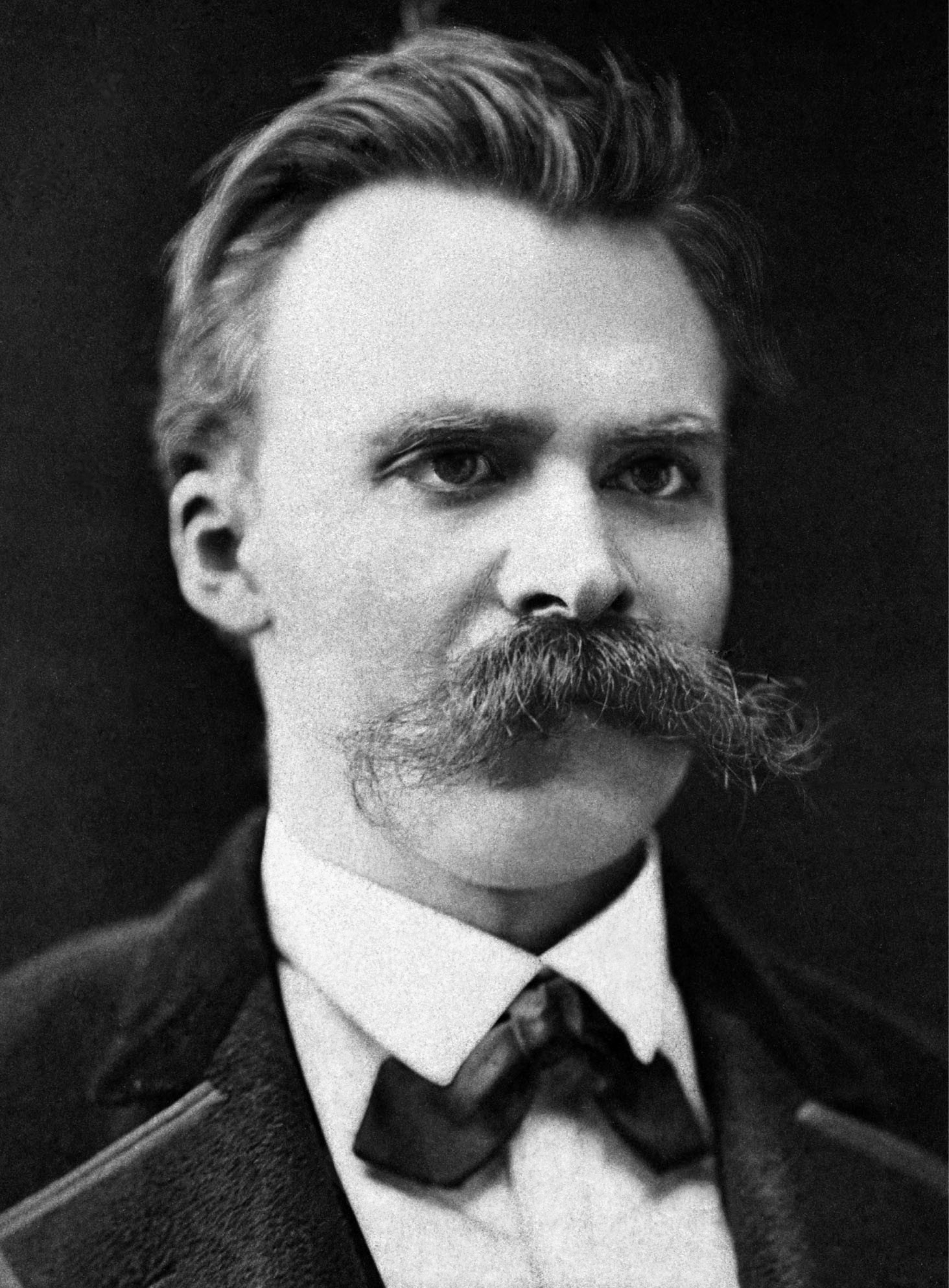


This photographic portrait of Friedrich Nietzsche, taken by Gustav Schultze in his Naumburg studio in September 1882, is one of the most reproduced images of the philosopher. Nietzsche is shown at age 37, in the productive middle period that would produce Thus Spoke Zarathustra (1883 to 1885), Beyond Good and Evil (1886), On the Genealogy of Morals (1887), Twilight of the Idols (1888), and The Antichrist (1888). The famous mustache, the deep-set eyes, and the high forehead form the canonical visual of the late nineteenth century's most consequential philosopher.
Nietzsche (1844 to 1900) trained as a classical philologist, was appointed professor at the University of Basel at age twenty-four, resigned the chair ten years later on grounds of poor health, and produced his major works during the decade of nomadic life that followed (Sils-Maria, Genoa, Turin, Nice). The will to power, the eternal recurrence, the genealogy of morality, the death of God, the Übermensch, and the critique of Christian and Platonic metaphysics constitute the conceptual repertoire that would shape twentieth-century continental philosophy from Heidegger to Foucault to Deleuze.
The Schultze portrait was taken during Nietzsche's brief romantic and intellectual involvement with Lou Andreas-Salomé and Paul Rée. The photograph captures Nietzsche at the apex of his productive powers; the catastrophic mental collapse in Turin in January 1889 would end his philosophical work entirely, and the final eleven years of his life were spent in the care of his mother and then his sister Elisabeth, who would systematically distort his manuscripts to serve her own political program. The photograph is in the public domain and held in multiple institutional archives.