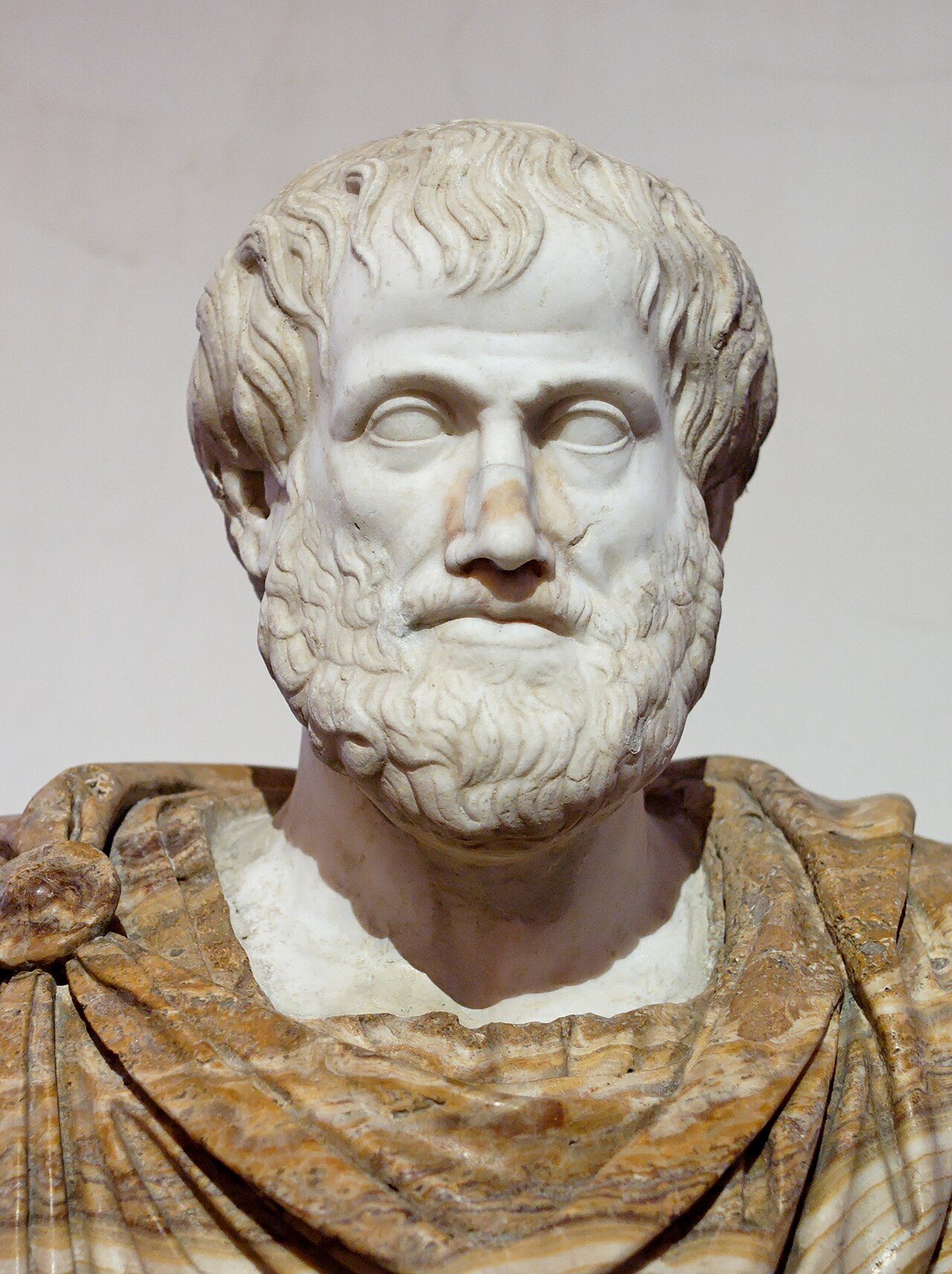


This portrait bust of Aristotle, held in the Palazzo Altemps collection of the Museo Nazionale Romano, is one of the most authoritative ancient images of the philosopher. The bust is a Roman marble copy after a lost Greek bronze original attributed to the workshop of Lysippos, dated to the late fourth century BCE, close enough to Aristotle's own lifetime (384-322 BCE) to carry significant iconographic weight.
Aristotle's intellectual output is the densest single body of work in the Western philosophical canon: physics, metaphysics, biology, ethics, politics, rhetoric, poetics, logic. He founded the Lyceum in Athens in 335 BCE; his lecture notes, transmitted through Andronicus of Rhodes in the first century BCE, became the corpus that defined the curriculum of medieval Islamic and Christian universities for a thousand years.
The Altemps bust is in Rome. Iconographically it represents the moment Aristotle had become the canonical reference figure, the calm, mature philosopher whose authority the Aristotelian tradition would rest on through Aquinas, Avicenna, and the Scholastics. Every later portrayal of 'a philosopher' in Western art descends in part from this register.