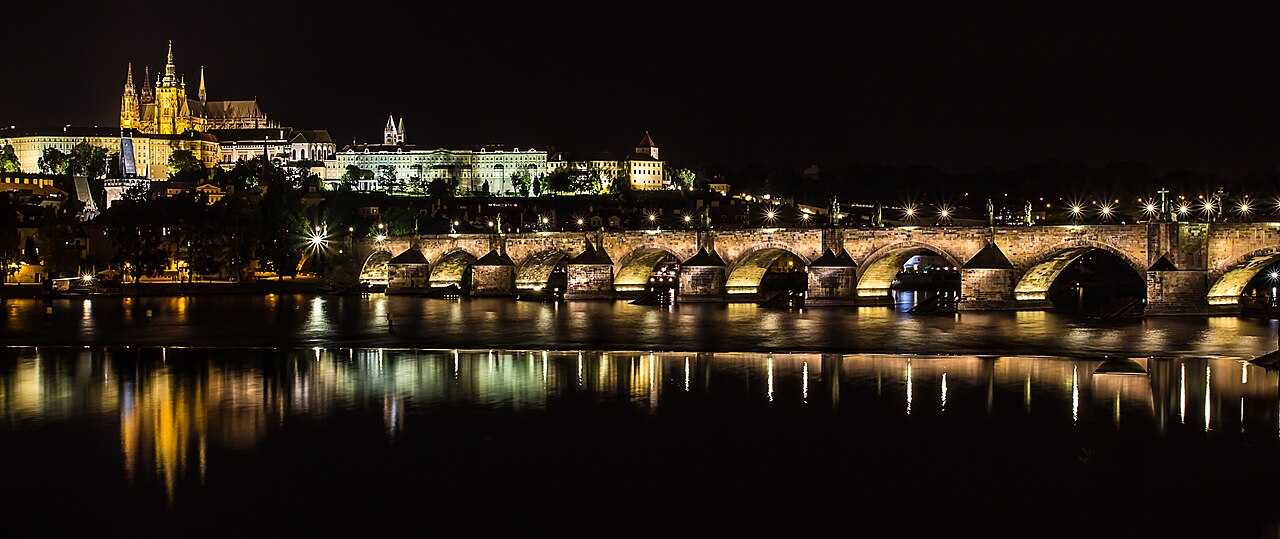



The Charles Bridge (Karlův most) is a stone arch bridge over the Vltava River in Prague, commissioned by King Charles IV of Bohemia in 1357 and completed around 1402. It is one of the oldest surviving stone arch bridges in continuous use in Europe. Across its 516-meter length stand thirty Baroque statues of saints, mostly installed between 1683 and 1714, the most famous being the statue of St John of Nepomuk (1683), which became a pilgrimage site within the century of its installation.
The bridge connects the Old Town of Prague to the Lesser Quarter (Malá Strana) and the route up to Prague Castle. For five hundred years it was the only crossing of the Vltava in the city; the king's coronation processions, the imperial entries of the Holy Roman Emperors (Prague was the imperial capital under Charles IV and Rudolf II), and the daily commerce of medieval Bohemia all passed across its stones.
Prague itself is the largest substantially preserved medieval European capital. The Old Town, the Lesser Quarter, the Castle complex, and the cathedral of St Vitus together form one of the largest continuous medieval urban landscapes in the world. The Charles Bridge is the photographic anchor of that landscape, the single most-reproduced image of Prague and one of the most-recognized urban photographs in Central European visual memory.