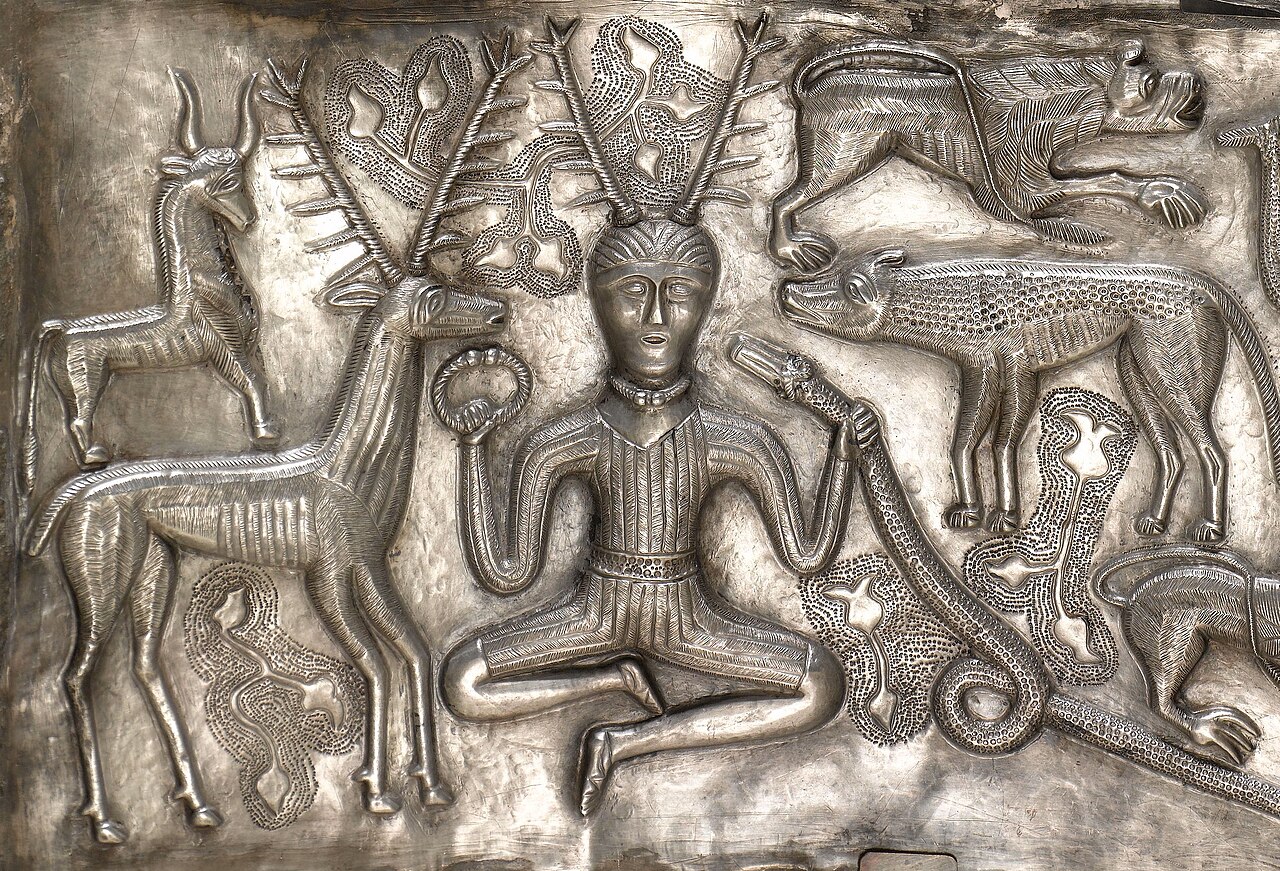


This detail from the Gundestrup Cauldron shows the horned god identified by archaeologists as Cernunnos: cross-legged, antlered, holding a torc in one hand and a ram-horned serpent in the other, surrounded by stag, lion, and other animals. The cauldron, a partially gilded silver vessel weighing nearly nine kilograms, was discovered in 1891 in a peat bog at Gundestrup in northern Jutland, Denmark, dismantled into thirteen plates and the base disk. It is the single most important artifact for the iconography of pre-Christian Celtic religion in Iron Age Europe.
Cernunnos (a name attested in the singular inscription on the first-century CE Pillar of the Boatmen in Paris) is the Celtic horned god of forests, animals, fertility, and the underworld. The cross-legged seated pose, the antlers, the torc, and the horned serpent recur consistently across Iron Age and Romano-Celtic Gaul, from this Gundestrup plate through the Reims and Cirencester stelae and dozens of bronze and stone reliefs across France, Britain, and Ireland. The figure is the principal surviving male deity of the pre-Christian Celtic pantheon and the iconographic ancestor of the Green Man and a long line of European folk-religious figures.
The cauldron is held in the National Museum of Denmark in Copenhagen. Its origin is disputed: stylistic and metallurgical evidence suggests manufacture in Thrace or by Thracian craftsmen on commission from a Celtic patron, with the iconography drawn from Celtic religious imagination. The Gundestrup Cauldron is, with the Battersea Shield and the Snettisham Torc, one of the three or four most important artifacts in the entire surviving inventory of Iron Age European metalwork.