1500s
8 posts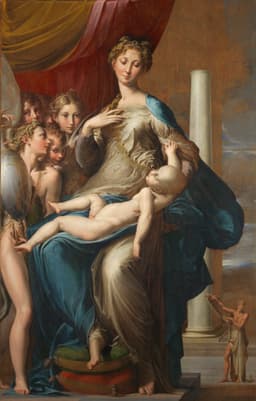
Madonna with the Long Neck
Painting · Parmigianino
Parmigianino's Madonna with the Long Neck (1535) is a defining work of Mannerism, its elongated proportions and cool elegance a deliberate departure from High Renaissance balance.Crosses Mannerism × P

Bacchus and Ariadne
Painting · Titian
Titian's Bacchus and Ariadne (1523) is a high point of the Venetian Renaissance, the god leaping from his chariot toward Ariadne in a blaze of ultramarine.Crosses Renaissance × Painting × Greek Mythol
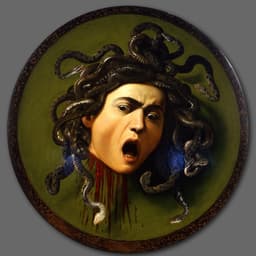
Medusa
Painting · Caravaggio
Caravaggio's Medusa (c. 1597), painted on a ceremonial parade shield, fixes the Gorgon at the instant of decapitation, the scream and serpents rendered with the violent realism that drove the whole Ba
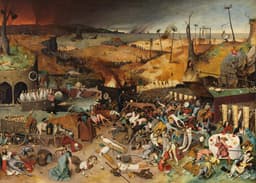
The Triumph of Death
Oil on panel · Pieter Bruegel the Elder
Pieter Bruegel the Elder painted The Triumph of Death around 1562. Across a scorched, panoramic landscape, an army of skeletons harvests the living without distinction of rank: a king's gold is tipped
The Ambassadors
Painting (oil on oak) · Hans Holbein the Younger
Painted in 1533, Holbein's The Ambassadors depicts the French ambassador Jean de Dinteville and the bishop-diplomat Georges de Selve standing on either side of a two-tiered table loaded with the instr
Melencolia I
Engraving · Albrecht Dürer
Engraved by Albrecht Dürer in 1514, Melencolia I is the most analyzed single print of the entire Northern Renaissance. A winged personification of Melancholy sits at the right, head propped on her han
Portrait of Georg Gisze, Merchant of the Hanseatic League
Painting (oil on oak panel) · Hans Holbein the Younger
The painting is an inventory in oil. On the table in front of the merchant: a folded letter, addressed to him ("To the honourable Georg Gisze in London, in England, to my brother"), a glass vase of ca
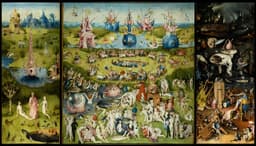
The Garden of Earthly Delights
Triptych (oil on oak panels) · Hieronymus Bosch
Five centuries of writing have not produced a stable reading of this triptych, and the failure is significant. Most paintings yield to interpretation by the second generation of critics. Bosch's centr