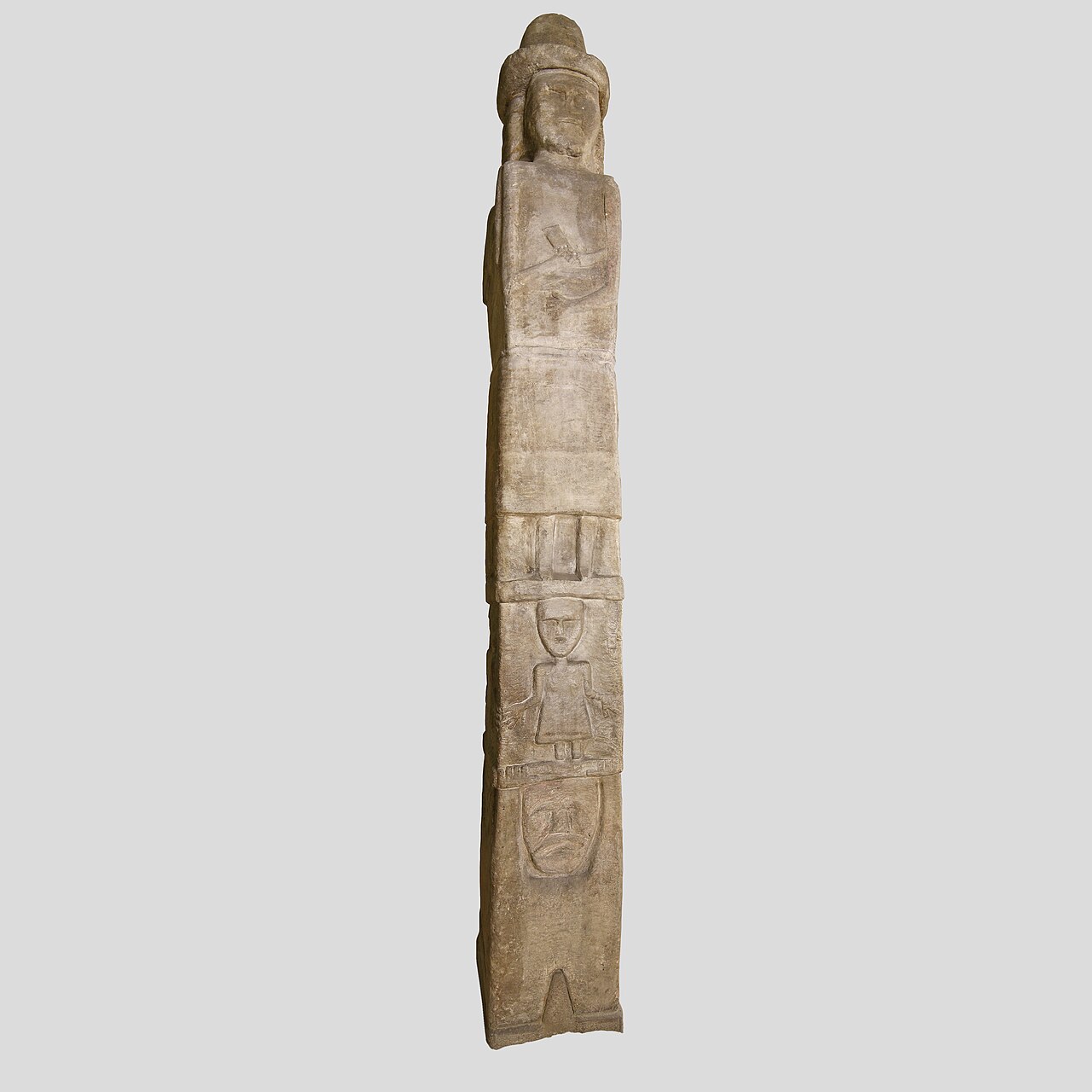



The Zbruch Idol is a 2.67-meter limestone pillar with four faces sharing a single conical cap, discovered in 1848 in the Zbruch River near the village of Lychkivtsi in what is now western Ukraine. It is the single most important surviving artifact of pre-Christian Slavic religion. The four faces, with the bodies extending down the pillar in three tiers, are conventionally identified with the four-faced god Svetovid (or Sventovit) known from medieval chronicle accounts of the Slavic cult center on the island of Rügen in the Baltic, destroyed by Danish forces under King Valdemar I in 1168 CE.
The three tiers of the pillar are read as a cosmological diagram: the upper tier showing the four principal deities (Svetovid, Lada, Perun, Mokosh, with their attributes of horn, ring, sword and horse, and other figures), the middle tier showing dancing humans, and the lower tier showing a kneeling figure supporting the world. The iconographic program represents the tripartite Slavic cosmos of sky, earth, and underworld, with the four-faced god surveying all four directions from above. The pillar is one of the most explicit pre-Christian Slavic cosmological monuments to survive in its original form.
The original is held at the Archaeological Museum in Kraków, Poland. Authenticity has been debated since the discovery: a minority of scholars have argued the pillar is a nineteenth-century Romantic forgery, but the dominant view based on stratigraphy, weathering analysis, and stylistic comparison with other early-medieval West Slavic religious monuments places the manufacture between the ninth and tenth centuries CE, possibly at a regional cult site connected to the broader Rügen tradition. Several modern replicas stand in Ukraine, Poland, Russia, and the Czech Republic.