

Leonardo solved a problem that two generations of earlier Italian humanists had failed to solve. The Roman architect Marcus Vitruvius Pollio, writing in the first century BCE, had asserted that the proportions of a well-made man could be inscribed within both a circle and a square, the two perfect geometric forms. Vitruvius did not draw the figure; he gave only the proportional rules. Renaissance humanists rediscovered the De architectura around 1414 and immediately set about trying to produce the illustration Vitruvius had not. Most of them failed. The figures they drew had to have arms and legs in postures that, when checked against the geometry, did not fit either the circle or the square. The mathematics held; the figures distorted to make it visible.
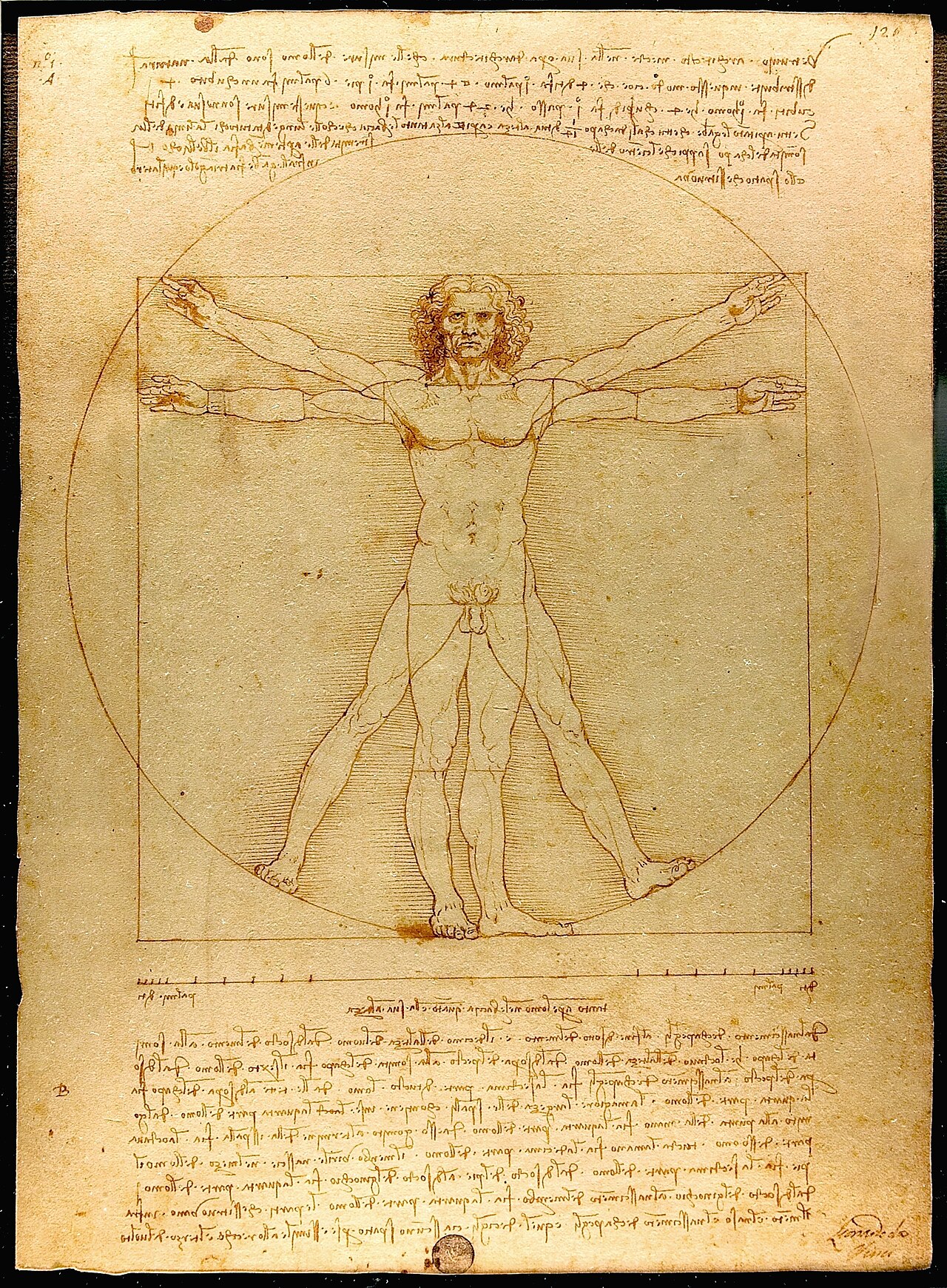
Leonardo's drawing, made around 1490 in Milan during his employment at the Sforza court, solved the problem by allowing the figure to take two superimposed poses simultaneously. Arms outstretched horizontal, feet together: the figure fits the square. Arms raised at a forty-five degree angle, legs spread to match: the figure fits the circle. Both positions share the navel as the centre of the circle and the groin as the centre of the square. The trick is that the two centres are different points. Vitruvius had said the human body has a single ideal centre; Leonardo's drawing says it has two, and the two relate by being the visible distance between geometric perfection and lived anatomy.
The notes around the drawing, written in Leonardo's characteristic mirror script, transcribe Vitruvius's measurements directly. The length of outspread arms equals the height of the man. From hairline to bottom of chin is one tenth of the body. The foot is one seventh. The neck is one ninth. The drawing reads as a worked example of the proportions, not as an autonomous artwork; it lives inside Leonardo's working notebooks and was never intended for exhibition. It now belongs to the Gallerie dell'Accademia in Venice and is exhibited at most once a decade because the paper is fragile and exposure to light degrades the iron-gall ink Leonardo used.
The image's twentieth-century afterlife as the universal logo of human-centred design (medical, scientific, technological) is a kind of historical irony. Leonardo drew the figure as a piece of Vitruvian commentary, not as a humanist manifesto. The drawing has been recruited, against the grain of its origin, to serve as iconography for the modern world's belief that humanity is the measure of all things. Vitruvius would have agreed with the recruitment; Leonardo, characteristically, gave no sign either way.