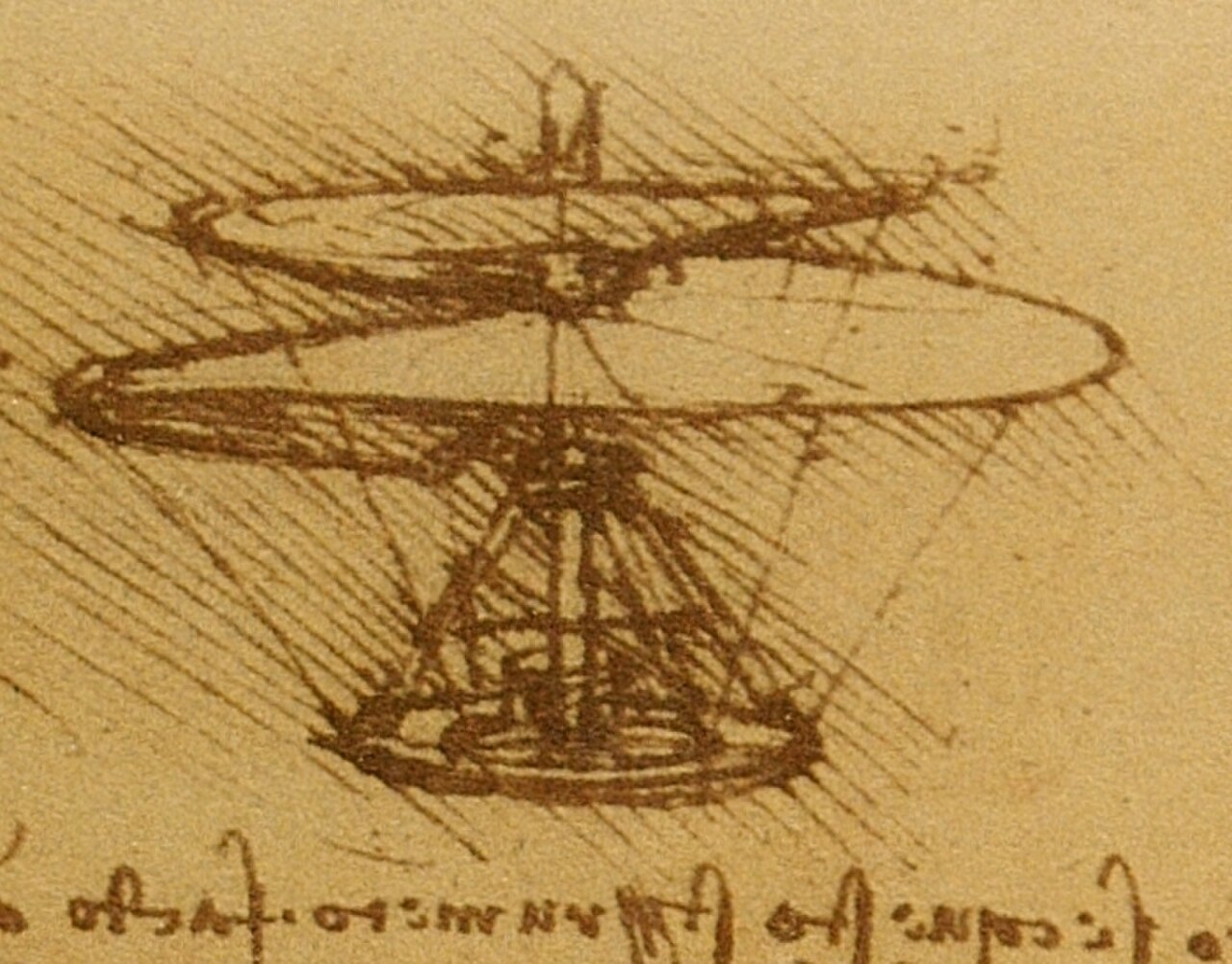


Leonardo's sketch of an aerial screw, made around 1483 in Milan, is the founding document of helicopter aerodynamics. It does not work. The torque required to spin the canopy at the speed needed for lift is beyond muscle power; Leonardo specified four men running around a central platform to power it, which would not have been enough. He did not solve the counter-rotation problem either: as the canopy spins, the platform spins in the opposite direction, and the men running on it would have generated lateral motion rather than vertical. The first practical helicopter was Sikorsky's VS-300 in 1939, four hundred and fifty years after Leonardo's notebook entry.
He saw the principle, even if he could not build it. The note beside the sketch reads, in his mirror script: "I find that if this instrument made with a screw be well made, that is to say, of linen of which the pores are stopped with starch, and be turned swiftly, the said screw will make its spiral in the air and it will rise high." That is rotary-wing aerodynamics, described correctly, four and a half centuries before anyone could build a machine that confirmed it. Leonardo arrived at the principle by analogy with screws driving through wood: if a helical surface can compress a solid medium downward by rotation, perhaps it can do the same to a gaseous one upward.
Leonardo's flying-machine notebooks contain many such intuitions. Most do not work. A few are approximately right: the parachute he sketched in 1485, a four-sided pyramid of stiff linen seven metres across, was successfully tested by skydiver Adrian Nicholas in 2000 using only materials available in Leonardo's time, and held a stable descent. The aerial screw has not been similarly redeemed. It cannot be built into a functional craft using contemporary materials and remain faithful to the design. Engineers since the nineteenth century have treated it as the founding gesture of helicopter aerodynamics while refusing to build it.
The drawing lives in the Codex Atlanticus at the Biblioteca Ambrosiana in Milan, the largest single collection of Leonardo's working notes (one thousand one hundred and nineteen folios). It is exhibited in temporary form periodically and reproduced everywhere. A full-scale reconstruction was hung at the entrance of the Salone Nautico Internazionale in Genoa in 1980. The reconstruction is a sculpture, not a vehicle, which is the most honest available treatment of Leonardo's actual achievement: not a working machine but a successful piece of speculative engineering, the moment a problem first announces itself in the form that will eventually permit a solution.