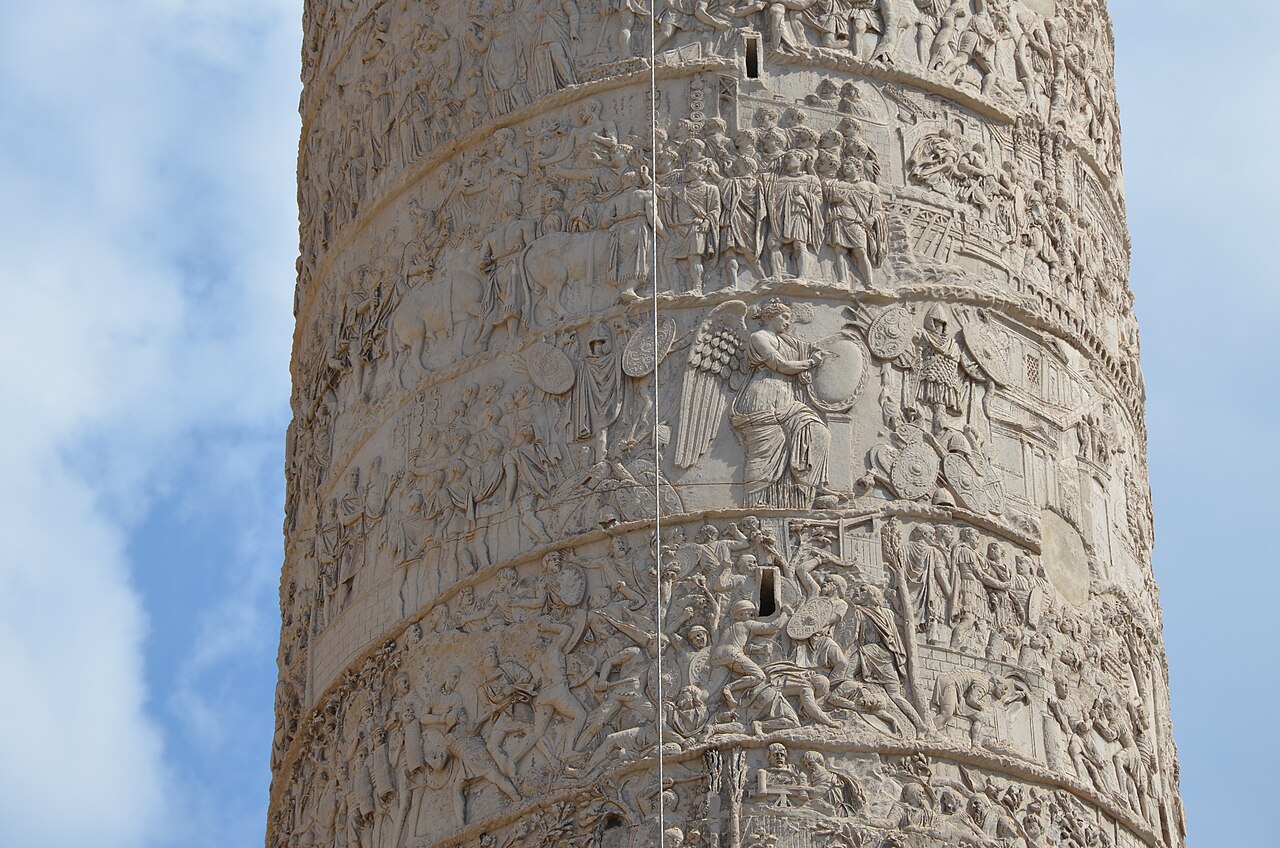



Trajan's Column was dedicated in 113 CE in the Forum of Trajan in Rome to commemorate the emperor Trajan's two military campaigns in Dacia (101-102 and 105-106 CE). The column stands approximately 30 meters tall (39 meters with the pedestal); a continuous spiral relief 200 meters long wraps the shaft, depicting 2,500 figures across 155 scenes from the Dacian Wars. It is the single most ambitious narrative-sculptural project of the entire Roman Empire and one of the foundational documents of Roman military history.
The relief documents the wars in extraordinary specificity: bridge construction over the Danube, fort construction, legionaries on the march, ritual sacrifices, the death of the Dacian king Decebalus, scenes of mass surrender. The Roman military uniforms, equipment, formations, and engineering work are depicted with the kind of documentary detail historians and archaeologists still use as primary source. The original bronze statue of Trajan that crowned the column was lost in the Middle Ages and replaced by a statue of Saint Peter in 1588.
The column stands in its original location in Rome between the Basilica Ulpia and the two libraries of the Forum of Trajan. It is the only structure of the Forum to survive substantially intact from antiquity into the present. Trajan's Column has functioned as the model for later commemorative columns from the Column of Marcus Aurelius (193 CE) through Napoleon's Vendôme Column (1810) to the Nelson Column in London (1843).