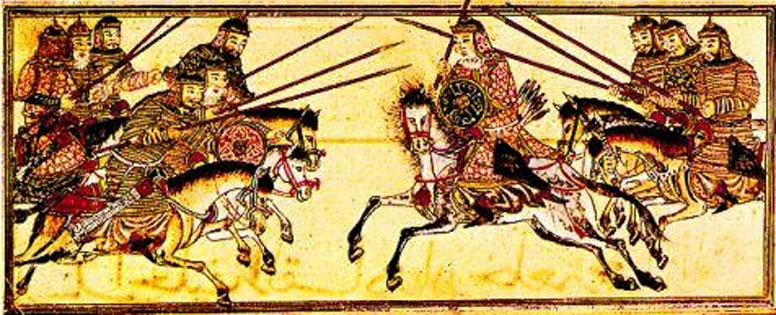



This illustration of Mongol cavalry comes from the Jami al-Tawarikh (Compendium of Chronicles), the Persian universal history compiled by the Mongol vizier Rashid al-Din between 1306 and 1311 CE under the patronage of the Ilkhanate ruler Öljaitü. The manuscript is one of the most ambitious historical-encyclopedic projects of the entire medieval Islamic world: it covered the history of the Mongols themselves, the history of the peoples they conquered (Chinese, Indian, European, Arab), and the prophetic-religious history of the world.
The cavalry illustrations document the Mongol military system that conquered the largest contiguous land empire in history under Genghis Khan and his successors (1206-1368 CE). The illustrated horses, bows, lamellar armor, and tactical formations represent the system that defeated the armies of the Khwarezmian Empire, the Jin Dynasty of China, the Kievan Rus, the Caliphate of Baghdad, and most of the kingdoms of Eastern Europe. The mobility of the Mongol cavalry, based on each warrior having three to five horses on campaign and a steppe-bred capacity for distance, was the operational core of their conquests.
The illustration is in the public domain. The Jami al-Tawarikh manuscripts are held variously at the Edinburgh University Library (Rashid al-Din's own copy, partial), the Topkapı Palace in Istanbul, and the Khalili Collection in London. They are the primary visual record of the Mongol military system from a contemporary source within the empire itself.