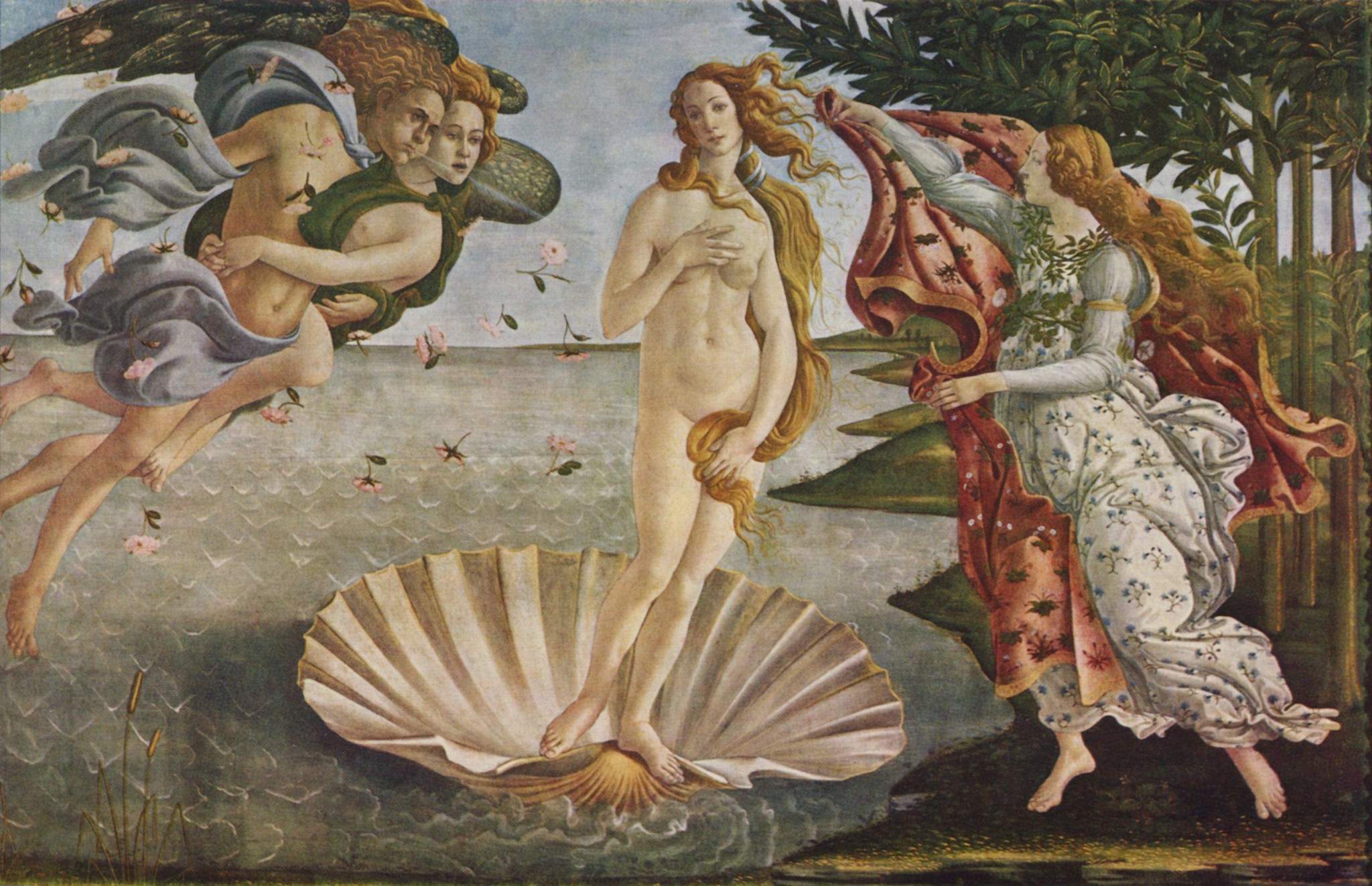



Painted around 1485 for the Medici circle in Florence, Sandro Botticelli's Birth of Venus shows the goddess Venus, the Greek Aphrodite, arriving on the shore of Cythera. Born of the sea foam, she stands on a great scallop shell; to her left the winged Zephyr and a nymph blow her to land, and to her right an attendant of the Hours reaches to clothe her in a flowered mantle. The figure follows the antique Venus Pudica pose, but Botticelli lengthens and lightens it into something weightless and linear rather than classical and solid.
It is among the first large-scale mythological canvases of the Renaissance not made for a church, a sign of the humanist revival of pagan antiquity under way in Medici Florence. Its Neoplatonic reading treats Venus as divine love and beauty descending into the world. The work hangs in the Uffizi Gallery in Florence and has become one of the most recognized images in Western art.