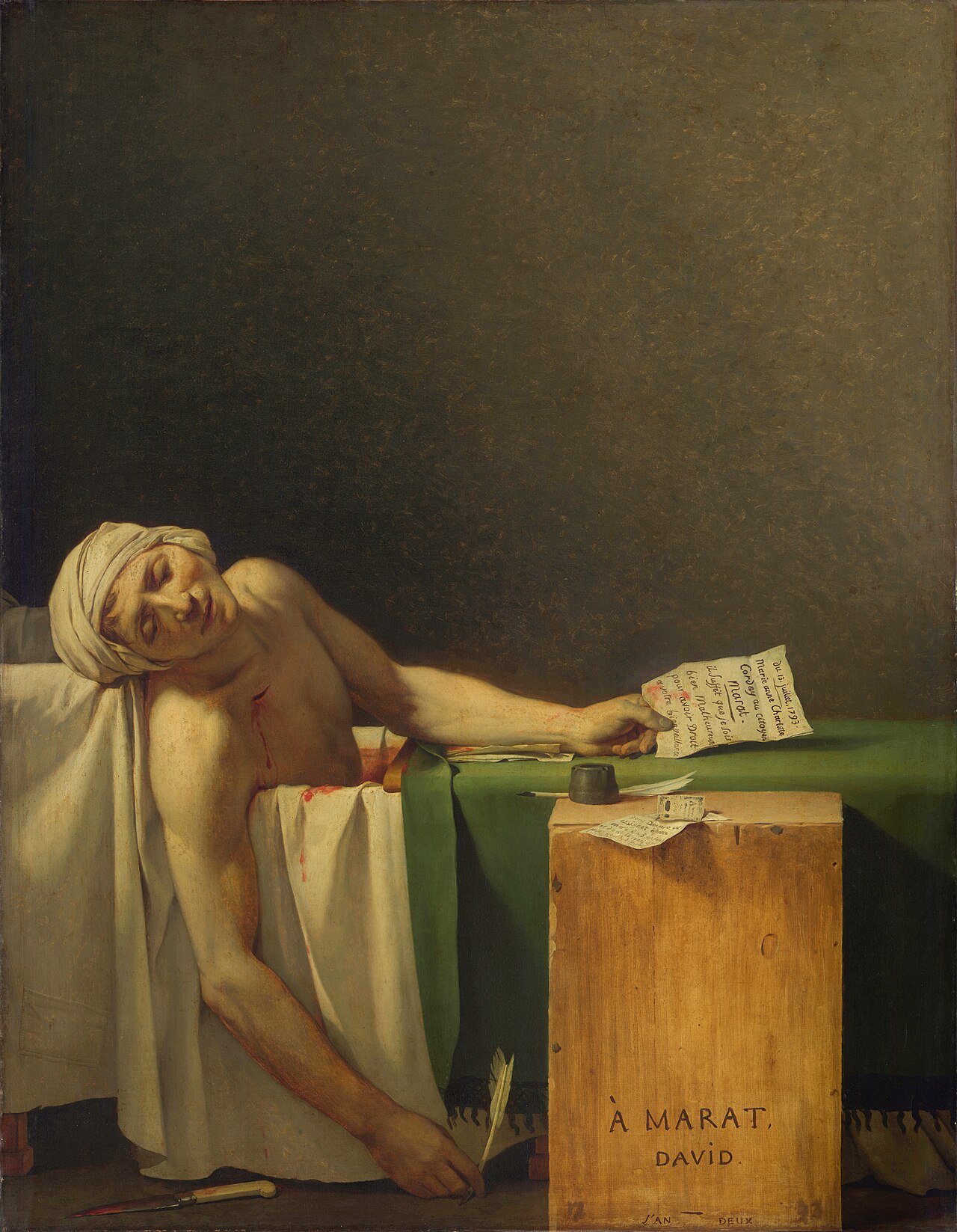


Jean-Paul Marat was murdered on the thirteenth of July 1793 by Charlotte Corday, a young woman from Caen who had travelled to Paris specifically to kill him. He suffered from a severe and disfiguring skin disease (likely dermatitis herpetiformis) that forced him to spend his days in a vinegar-soaked bath; he received visitors and edited his radical journal L'Ami du peuple from the tub. Corday talked her way in by promising the names of Girondist conspirators. She drove a kitchen knife into his chest. The historical Marat was a sick, foul-tempered, paranoid pamphleteer whose journal had explicitly called for the extra-judicial execution of thousands. David's painting is not the historical Marat.
David, a member of the Convention and Marat's friend, was tasked by the Jacobins with producing the official image of the murder. The propaganda question he was solving was specific: how to convert a hated radical into a martyr who would consolidate the Convention's authority. His solution was art-historical. He removed the skin condition. He gave Marat the body of a classical hero, the slump of a pietà, the wound of a saint. The note Corday brought is in his hand. The wooden crate beside him bears the inscription of his last request, that money sent to him be given to a war widow with five children. The background is empty. Corday is not there. There is no struggle. There is only the witness, and the witness is the viewer.
The painting was paraded through Paris at Marat's funeral and hung in the Convention chamber. After Thermidor and the fall of the Jacobins it disappeared from public view for forty years. David's success at making it work as a martyrology required the Jacobin reading of the Revolution to remain the dominant one; once that reading was politically defeated, the painting could not be exhibited without exposing its own propaganda function. The fact that it is now considered great art and was once considered an embarrassment is the same fact, viewed from two different settlements. The painting hangs at the Royal Museums of Fine Arts in Brussels, where David died in exile in 1825.