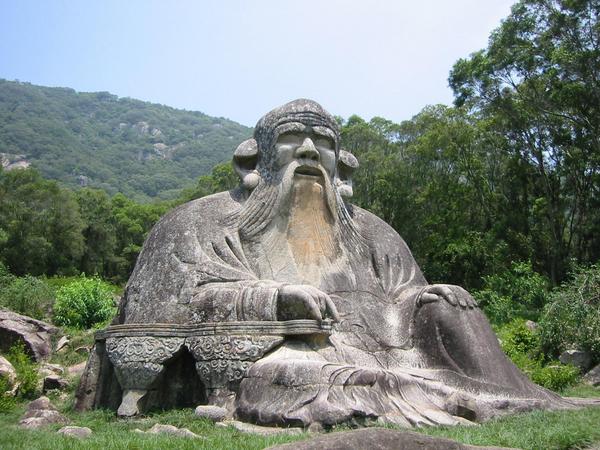



This depiction of Laozi mounted on a water buffalo follows the canonical iconography of the founder of Daoism: the white-bearded sage at the moment of his legendary departure westward through the Hangu Pass at the end of his life. According to the biographical tradition recorded in Sima Qian's Records of the Grand Historian (c. 100 BCE), the keeper of the Hangu Pass recognized that the old man riding the ox was a sage and refused to let him pass until he had committed his wisdom to writing. Laozi obliged with the Daodejing, the five-thousand-character text in eighty-one chapters that is the foundational scripture of Daoism and one of the most-translated books in human history.
Laozi (traditionally dated to the sixth century BCE, possibly contemporary with Confucius) is a quasi-legendary figure whose historical reality has been debated by sinologists since the early twentieth century. The Daodejing's compositional history is more probably a layered accretion across the fourth through second centuries BCE rather than the work of a single author. What is certain is that by the time of the Mawangdui silk manuscripts (168 BCE) and the Guodian bamboo slips (c. 300 BCE), the text in something like its present form was circulating as a foundational philosophical scripture.
The Daodejing's central concepts of the Dao (the Way), wu wei (non-action or effortless action), ziran (spontaneous naturalness), and the political doctrine of the sage-ruler who governs by appearing to do nothing, have shaped East Asian philosophical, political, and aesthetic thought for two and a half millennia. The Daodejing is, with the Bhagavad Gita and the Analects of Confucius, one of the three foundational texts of the great Asian philosophical traditions, and through Heidegger, Jung, and the twentieth-century reception of Asian thought in the West it has become a constitutive part of global philosophical literacy.