

The Carmina Burana is a manuscript collection of two hundred and twenty-eight Latin, Middle High German, and Old French poems, compiled around 1230 in the Bavarian Alps. It was rediscovered in 1803 at the Benedictine monastery of Benediktbeuern, from which it takes its name (carmina = songs, Burana = of Beuern). The poems are by anonymous goliards: wandering scholar-poets and clerics who had drifted out of the monasteries and universities of twelfth- and thirteenth-century Europe to drink, gamble, fall in love, and write savagely about the church that had trained them.
The contents are sorted into four sections: moral and satirical poems, love songs, drinking and gambling songs, and two longer religious dramas. The opening poem, O Fortuna, addresses the goddess Fortune as a turning wheel that lifts and crushes without reason; it became, after Carl Orff's 1936 setting, the most performed minute of medieval poetry in the modern repertoire. But the body of the manuscript is more various than Orff's twenty-four-poem selection suggests. The drinking songs are bawdy and structurally serious. The love poems alternate between sacred parody and direct address. The satires include attacks on simony, on monastic luxury, and on what the goliards called the curia romana, the papal court they understood as professionally compromised.
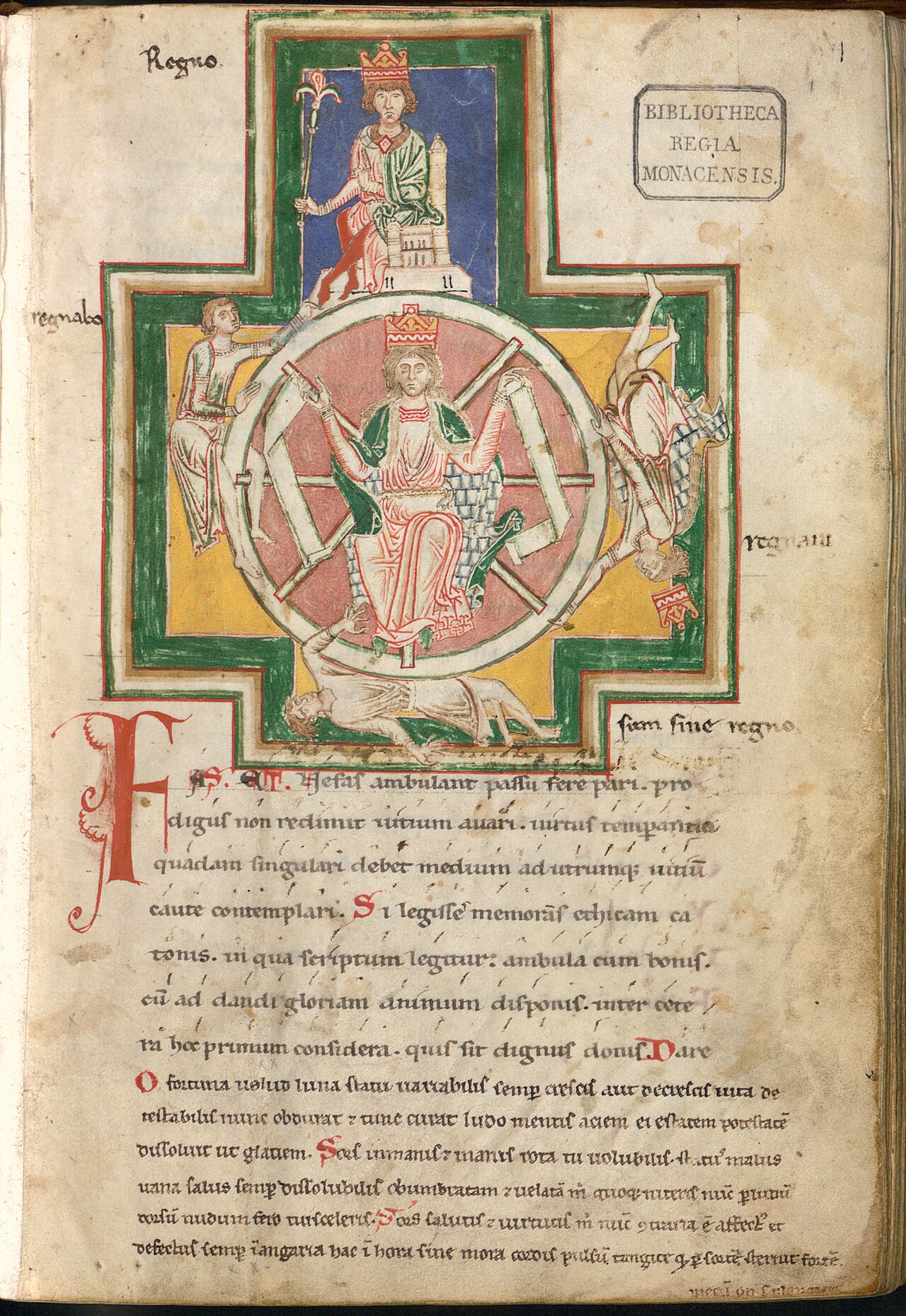
The manuscript itself is the artisanship the platform wants to surface. The Carmina Burana is illuminated, with miniatures including a famous depiction of Fortune's wheel at folio 1r, but it was made for working use, not for display. The script is workaday Bavarian Gothic. The page layout follows the practical conventions of monastic miscellany: songs in the order they were compiled, with later additions tucked into available spaces. Musical notations called neumes accompany about a quarter of the songs; the neumes indicate the rough melodic direction but not the precise pitches, which means the original melodies are recoverable only in fragments. The manuscript carries its own use; it is the working compilation of a community that owned and sang from it, not a presentation copy.
Orff's percussive setting is the work most people now think of when they hear the title. The original manuscript is the older and more various object underneath the setting. It sits at the Bavarian State Library in Munich, where it has been since 1806. The library's digital edition was released in 2014; the manuscript can be paged through online, folio by folio, with the neumes legible enough to follow if you have the training.