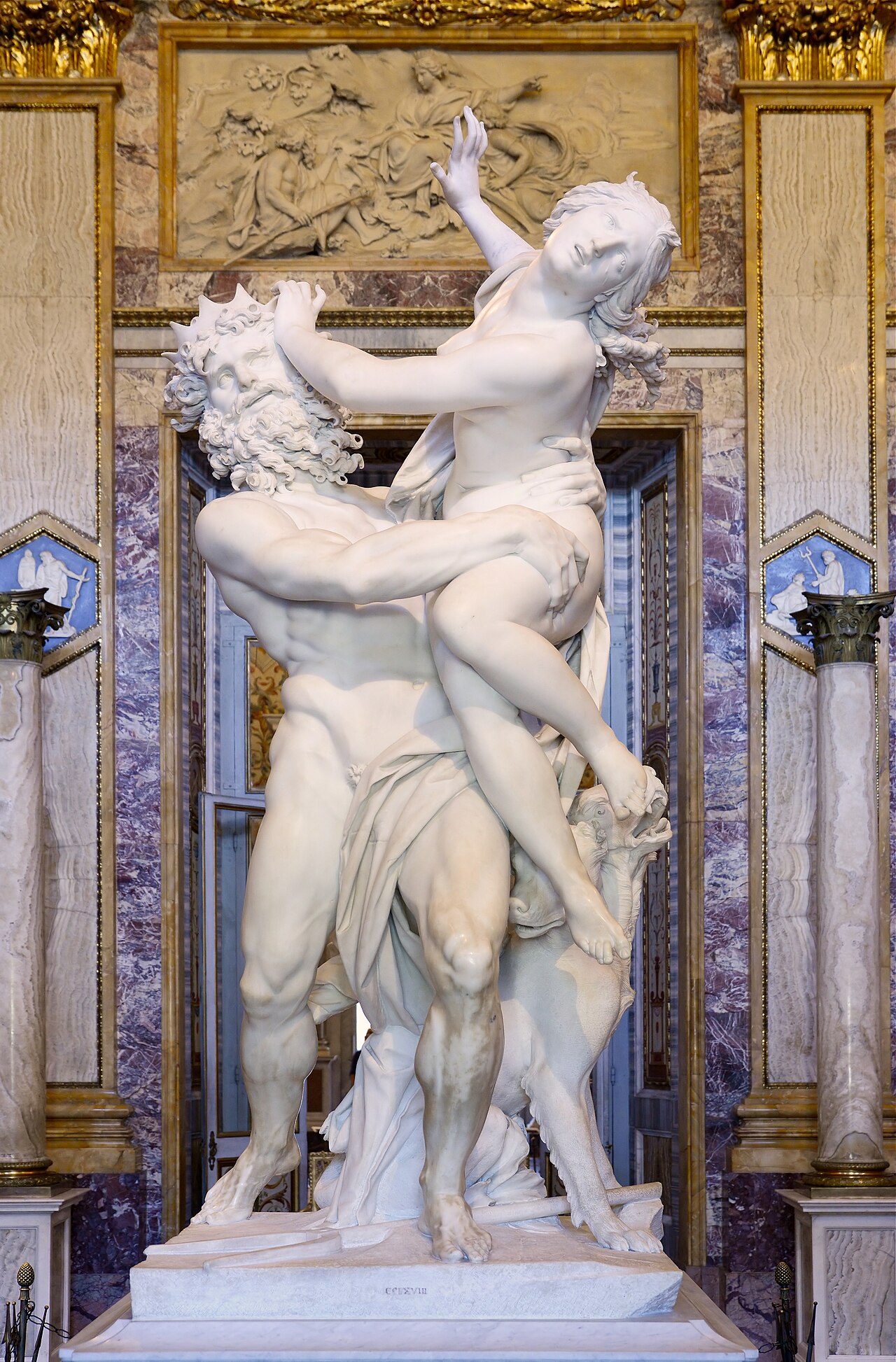


Bernini was twenty-three when he carved the Rape of Proserpina, finished in 1622 for Cardinal Scipione Borghese. The technical achievement that defines the sculpture is the deformation of marble flesh under Pluto's grip. Pluto's fingers press into Proserpina's thigh and waist. The marble dimples. Look from one viewing angle and the dimples appear where the fingers are. Walk three steps to the side. The dimples have moved, slightly, as the angle of light changes; another set of dimples is now visible where the previous angle had concealed them. Bernini has carved the depression of soft tissue under pressure at a resolution that exceeds the human eye's ability to take it in from any single position. The sculpture must be walked around.
The structural intent reinforces the carving. Bernini designed the Proserpina to be placed against no wall, in the centre of a room, with the viewer expected to orbit. Earlier sculptural narratives, going back to Greek antiquity, had a primary viewpoint: the figure was carved with one face for the audience and other angles treated as secondary. Bernini abandoned the primary viewpoint. The Proserpina has no front. It has only the orbit. The myth, in his treatment, becomes an event that resolves differently depending on where you stand. From one angle Pluto is triumphant. From another, Proserpina is escaping. From a third, Cerberus at their feet is the dominant figure. The sculpture cannot be photographed completely; any single image misses two of the three readings.
The myth itself is the abduction of Proserpina (Greek Persephone) by Pluto, god of the underworld, while she was gathering flowers in the meadows of Enna. Demeter's grief at her daughter's loss caused the earth to stop producing crops; the resulting bargain (Proserpina spends six months above ground, six months below) became the Greek and Roman explanation for the seasons. Bernini's sculpture is the moment of the abduction itself, with Pluto already on the threshold of the underworld and Proserpina's hand pushing back against his face. Her tears are individually carved. Her hair tangles. Pluto's beard creases against her arm.
The work stands at the Galleria Borghese in Rome, in the room Cardinal Borghese commissioned to display it. Borghese moved the sculpture once, in 1623, as a political gift to Cardinal Ludovisi, but it was returned to the Galleria in the nineteenth century and has stood in its commissioned position since. It is one of the few major works of European sculpture that still occupies the room it was made for, with the orbit Bernini designed still available to walk.