

Ovid's account of Pygmalion in the Metamorphoses is a single short story embedded in a longer poem about transformation. A sculptor of Cyprus, repulsed by the women of his city, carves an ivory statue of his ideal woman and falls in love with it. He kisses it, dresses it, brings it offerings. At a festival of Venus he prays for a wife as beautiful as his sculpture, and Venus, hearing the prayer's true meaning, grants it. When Pygmalion returns home and kisses the statue, the ivory grows warm, the lips soften, the body moves. Ovid does not tell us the statue's name. The Greek tradition called her Galatea, but that name was attached to the myth only after Ovid; it is not in his text.
The myth is harder than its romantic afterlife makes it. Pygmalion has prayed not for a real woman but for the statue to become real. Venus has granted the wish on the statue's terms, not on the woman's. The newly-living being has not consented to the transformation; she has not had a prior life with preferences, history, or refusals; she awakens already in Pygmalion's bed, already kissed by him, already loved into being by a man who explicitly chose her because she was made rather than born. The myth pretends to be about the power of love to bring stone to life. It is also, on a less generous reading, about the power of a maker to create an object whose moral status as an autonomous person is precisely the question the myth refuses to settle.
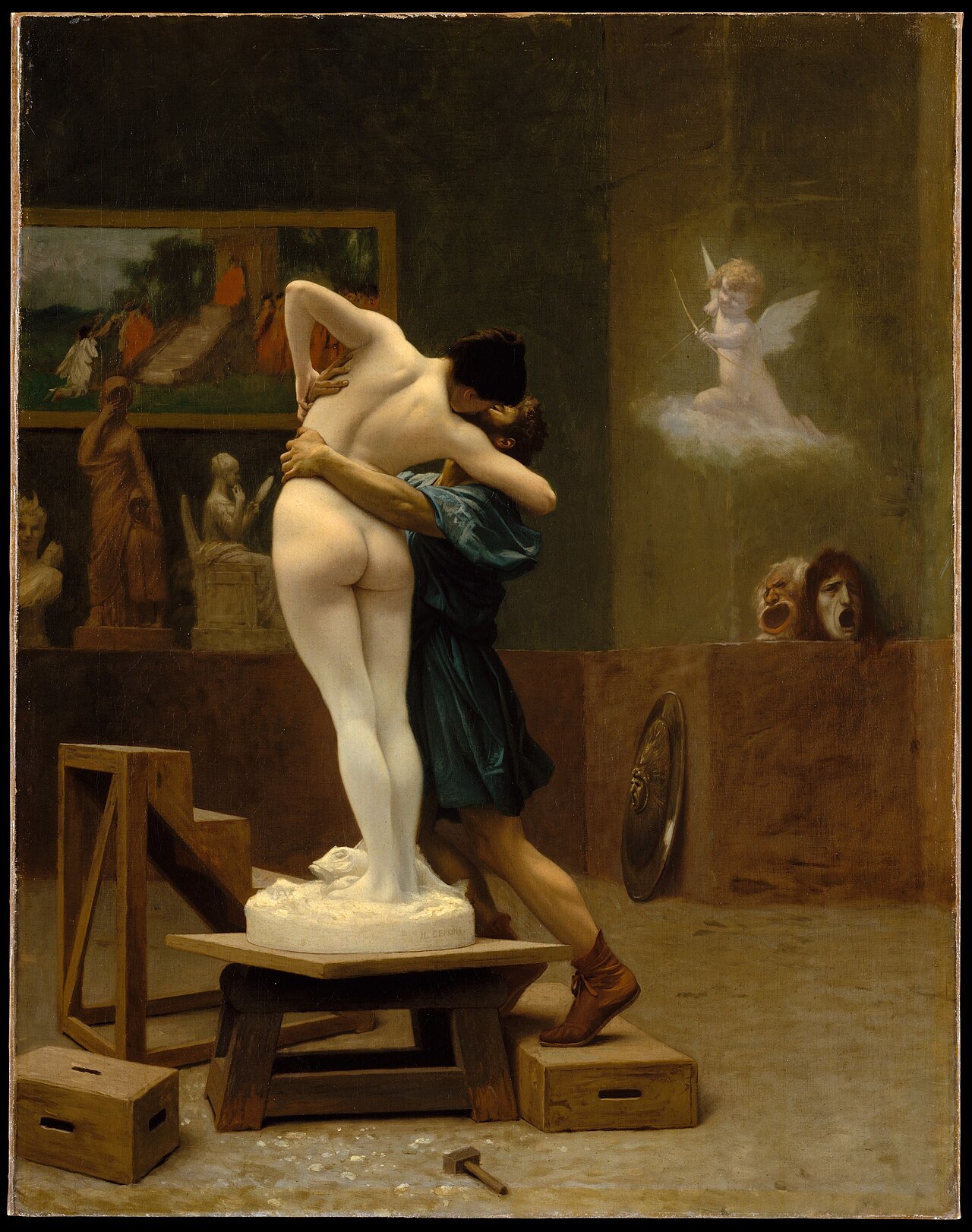
Gérôme painted the moment of transformation around 1890, and his interpretation is unusually attentive to the moment's strangeness. The statue's feet are still marble. Her thighs are already flesh. The transformation is being depicted at the boundary, mid-process, where Galatea is half-stone half-woman. Cupid hovers behind with bow drawn, his arrow tipped toward Pygmalion's heart. Pygmalion, half-clothed, reaches up and kisses her, and her arms (already alive) curl around his neck. Behind him, the studio is full of his other sculptures: a sphinx on a pedestal, a shield bearing Medusa's head, the unfinished masks of theatre on the wall. Each of the surrounding sculptures is a maker-fantasy about a difficult woman. None of them have come to life.
Gérôme made the painting three times in slightly different versions. The one at the Metropolitan Museum of Art in New York, given by the Tiffany family in 1927, is the canonical version. The myth Gérôme is painting is also (and he knew this) a parable about art: the maker who falls in love with what he makes, the prayer for the made thing to be more than a thing. Whether the transformation is a gift or a violation depends entirely on whom Ovid is overheard by. Gérôme's painting refuses to decide.